

How to start a nutrition practice: the Nimo playbook for dietitians
Small room, big follow-ups. A calm guide to your own practice.
- Typical space
- 100–200 sq ft, or fully online
- Time to open
- 3–6 weeks
- Registers with
- Local body; credentials vary
12 chapters · about 16 min read · updated
The 60-second version
- A nutrition practice is one of the lightest clinics to open. A good chair, a good scale, a quiet room and a booking link will carry you a long way. Many dietitians start online and add a room later.
- Your real product isn't the first consult. It's the follow-up. Plan your space, pricing and records around client number 30 coming back for their sixth visit.
- Paperwork is lighter than for a doctor's clinic, but it isn't zero: a local trade or establishment licence, possibly clinical establishment registration depending on your state, and GST questions for your CA.
- Keep your equipment honest and simple. A calibrated scale, a stadiometer and a measuring tape do more for your credibility than a body-composition machine you don't trust.
- Price in packages that match how change happens (often a month or three), not single visits. Never sell an outcome ("lose 8 kg in 30 days").
- Your first 50 clients usually come from three places: referring doctors, people who already know your work, and a clear Google Business Profile with a booking link.
- Write every diet chart as if the client will read it alone on a Tuesday night, because they will.
Before you sign a lease
Do you need a room at all? Many nutrition practices in India start online: a video call, a diet chart sent to the client's phone, and a follow-up booked for two weeks later. That's a perfectly good first year. A physical room helps when your clients are older, when referring doctors want to send people round the corner, or when you want to take measurements you trust.
If you do take a room, think about who walks in:
- Near a diabetologist, gynaecologist or paediatrician. These are your most natural referral partners (diabetes, PCOS and pregnancy, children's growth). Being two floors up from one is worth more than a main-road signboard.
- Inside a gym, physio clinic or yoga studio. A shared or rented room by the hour can be a low-risk start. Agree in writing who owns the client relationship and the records.
- In a residential neighbourhood. Good for families and older clients who want to walk in. Check parking and whether the stairs are kind to knees.
Rent vs. home practice. A room in your home keeps costs close to zero, but think about privacy for your family, a separate entrance, and whether your local body allows a professional establishment in a residential building. Rules differ by city, so ask before you print a board.
How many rooms? One is enough. You want a consult space where a client can sit comfortably beside you (not across a big desk), plus a corner with a little privacy for weighing and measuring. Waiting space can be two chairs. Clients rarely wait long for a dietitian, and when they do, it's usually a sign your slots are too tight.
Nimo tip: Before you sign, sit in the room at 6 pm on a weekday. Evenings are when working clients book, and that's when you'll find out about the traffic noise, the generator next door and the lift that stops at 7.
Paperwork and registrations
Dietetics in India sits in a slightly unusual place: you aren't registered with a medical council the way a doctor is, and the rules for allied and healthcare professionals are still being set up in many states. That makes it more important, not less, to ask the right questions early. Rules differ by state. Confirm with your local body, your state's health department and a CA before you open. Treat the table below as a list of things to ask about, not legal advice.
| What | Who issues it | When |
|---|---|---|
| Your qualification and credentials (degree, and the Registered Dietitian credential from the Indian Dietetic Association if you hold it) | Your university; Indian Dietetic Association | Keep copies ready before you open; display them in the room |
| Allied and healthcare professional registration | The state council under the National Commission for Allied and Healthcare Professions Act, 2021, where your state has set one up | Ask now; registers are still being set up in many states |
| Shops & Establishment registration or trade licence | Your municipal corporation or local body | Before opening day, once you have the rental agreement |
| Clinical establishment registration | Your district registering authority, in states that have adopted the Clinical Establishments (Registration and Regulation) Act, 2010 or their own act | Ask whether a dietitian's consulting room is covered in your state; many aren't, some are |
| GST registration (if needed) | GST department, via your CA | Ask your CA early. Whether your services are exempt depends on how you're set up, and selling products changes the picture |
| FSSAI registration | Food Safety and Standards Authority of India | Only if you plan to sell supplements, meal plans with food, or packaged products |
| Professional indemnity insurance | A general insurer | Before your first client. It's inexpensive and worth having |
Two more things to think through before you start:
- Online consults across state lines. If you see clients in other states, ask your CA how you invoice them, and keep a clear consent and record for every online session.
- Supplements. Recommending a supplement is different from selling one. If you stock and sell, you're now running a small shop too, with its own paperwork. Many dietitians decide not to, and simply write the recommendation down.
Setting up the room
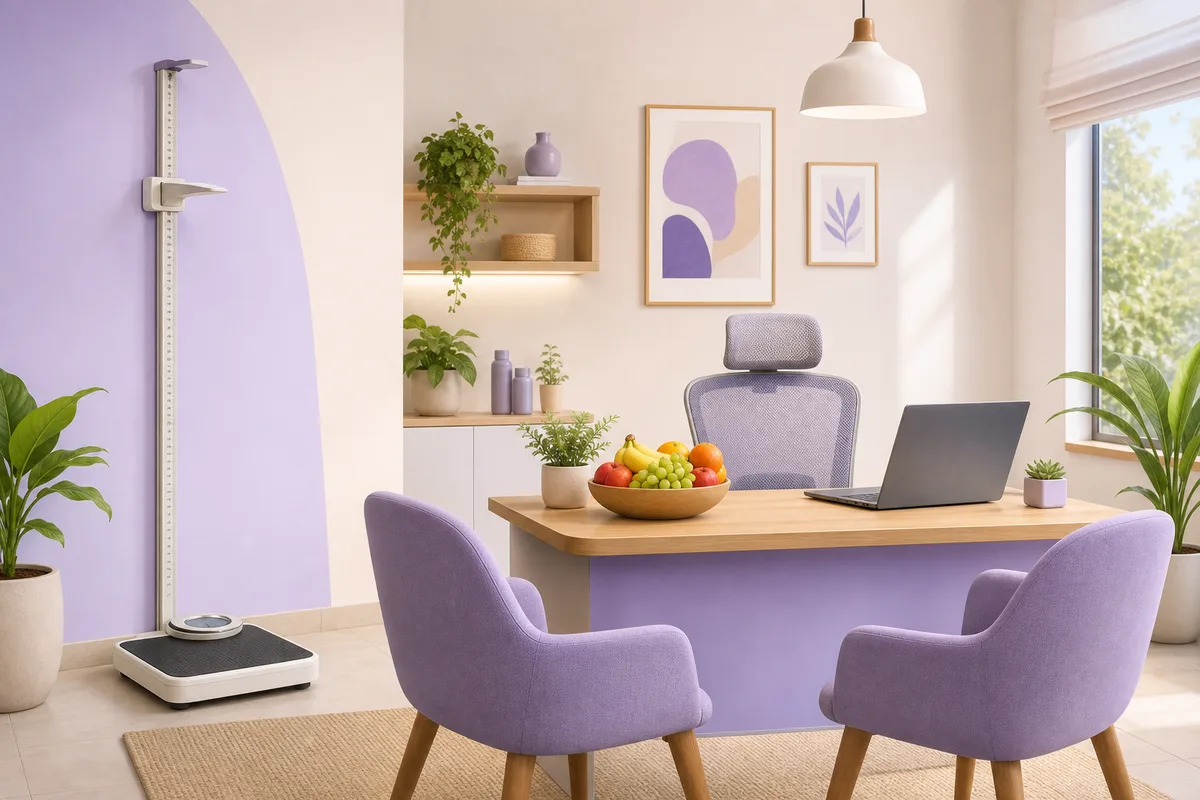
Rough ranges, which vary a lot by city and by how new you buy:
| Item | Must-have / Nice-to-have | Rough cost |
|---|---|---|
| Digital weighing scale (calibrated, up to 150–180 kg) | Must-have | ₹1,500–₹6,000 |
| Wall-mounted stadiometer | Must-have | ₹1,000–₹4,000 |
| Non-stretch measuring tape (waist, hip, mid-arm) | Must-have | ₹100–₹500 |
| Comfortable chairs for you, the client and one family member | Must-have | ₹6,000–₹20,000 |
| Small desk, good light, a lockable cupboard for paper records | Must-have | ₹8,000–₹25,000 |
| Portion visuals: a real katori, ladle, glass and plate set | Must-have | ₹500–₹2,000 |
| Phone stand, ring light and headset for online consults | Must-have if you go online | ₹2,000–₹6,000 |
| Printer for diet charts and receipts | Nice-to-have | ₹6,000–₹15,000 |
| Body-composition analyser | Nice-to-have | ₹8,000–₹1,50,000+ |
| Skinfold calipers | Nice-to-have | ₹1,000–₹15,000 |
| Paediatric scale and infantometer (if you see children) | Nice-to-have | ₹3,000–₹12,000 |
| Food-label display and sample packs for label-reading sessions | Nice-to-have | ₹500–₹2,000 |
A note on body-composition machines: they impress clients on day one and confuse them by day thirty, when hydration or a heavy lunch moves the numbers. If you buy one, buy it for trend-watching with the same client at the same time of day, and explain that clearly. The tape measure is often the more honest friend.
Building your plans
This is the heart of a nutrition practice. Your "plan" is two things: the diet chart a client takes home, and the programme they sign up for.
The diet chart. Most Indian dietitians organise the day into a few familiar slots: early morning, breakfast, mid-morning, lunch, evening, dinner and bedtime. You don't have to fill all seven. A chart that only lists the meals a person actually eats is easier to follow than one that invents a mid-morning snack nobody has time for. A few habits that make charts stick:
- Use the client's own kitchen. If they eat rice at lunch, the chart should say how much rice, in a katori they own, not "complex carbohydrates".
- Write in household measures. One medium katori, two phulkas, a fistful of sprouts, one glass of buttermilk. Grams belong in your notes, if anywhere.
- Give swaps, not just rules. "If you're travelling, idli or poha instead of the oats" is a line people actually use.
- Plan for the family meal. Most clients don't cook separately. A chart that works with what the household already cooks wins.
- Leave room for festivals, weddings and fasting days. Ask about them in the first consult. They're coming whether the chart mentions them or not.
There's more on this, with a sample chart (labelled as an illustration, not a prescription), in our diet chart format guide and the post on writing a diet chart clients actually follow.
The programme. Decide your standard shapes before your first client asks "how does it work?":
- Single consult: an assessment and a first chart, for people who just want direction.
- One-month plan: first consult plus two or three follow-ups, chart revised each time.
- Three-month plan: the shape most lasting change actually needs, with fortnightly or monthly reviews.
- Condition-linked plans in partnership with a referring doctor (for example, a client with diabetes or PCOS whose doctor wants them to see a dietitian). Your role is the food plan. The diagnosis and medicines stay with the doctor.
Whatever the programme, write down in plain words what's included: number of follow-ups, how fast you reply to messages between visits, and what happens if a client misses a review.
Nimo tip: Keep a folder of five or six "starter" charts you've written yourself for common situations (a vegetarian office-goer, a new mother, a teenager in exam season). Never send one unchanged. Use it as the first draft you personalise in the room.
How a consult flows

First visit (45–60 minutes, in person or online)
- Front desk or booking link (before the day). Name, mobile, the reason for coming, and a request to bring recent lab reports and any doctor's notes.
- Measurements (5 minutes). Weight, height, waist, and anything else you use. Same scale, same time of day if you can.
- History (15–20 minutes). Medical history, medicines (as the client reports them), allergies, sleep, work hours, who cooks at home, activity, and what they've already tried.
- Diet recall (10–15 minutes). A 24-hour recall, plus a quick sense of how often they eat out, order in or skip meals. This is where the real plan comes from.
- Goals and the first chart (10–15 minutes). Agree on one or two changes they can actually make this fortnight. Write the chart, go through it line by line, and book the follow-up before they leave.
Follow-up (20–30 minutes)
Re-measure, then ask the only question that matters: what actually happened? Look at last visit's chart together, keep what worked, change what didn't, and send the revised chart the same day.
Online consults follow the same shape, with two adjustments: ask the client to weigh themselves at home on the same scale each time, and send the chart within an hour of the call while it's fresh for both of you.
If you have a helper, the handoff is simple: they handle booking, payments and reminders to bring reports. You handle everything said in the room. Clients will tell a dietitian things about food, body image and home life that they don't tell their doctor. That trust is your practice.
Pricing your consult
There's no single right number. It depends on your city, your experience, whether you're referral-led, and whether you're seeing clients in person or online. Some rough ranges, which vary a lot by city:
| Offer | Rough range |
|---|---|
| First consult (assessment + first chart) | ₹500–₹2,000 |
| Follow-up consult | ₹300–₹1,000 |
| One-month plan (first visit + 2–3 follow-ups) | ₹1,500–₹5,000 |
| Three-month plan | ₹4,000–₹15,000 |
| Online consults | Often similar to in-person; some practices charge slightly less |
A few ways to think about it:
- Price the follow-ups, not just the first hour. Packages make follow-ups feel included, which is exactly what keeps people coming back.
- Be clear about what's in the package. Unlimited chat support sounds generous until it fills your evenings. Say what "support between visits" means.
- Never price, or promise, an outcome. No "guaranteed results", no kilograms-per-month claims. Advertising cures or weight-loss results can also run into the Drugs and Magic Remedies (Objectionable Advertisements) Act, 1954, so ask before you put any claim in an ad.
- Have a fair refund line for packages, written down before anyone asks.
Your first 50 patients
Most dietitians call them clients, and most of the first fifty will come from people, not ads.
- Referring doctors. Visit the diabetologists, gynaecologists, paediatricians and GPs nearby. Bring a one-page note on what you do, how you'll send a summary back after each client's first visit, and your booking link. Then actually send that summary. It's the single best marketing you'll do.
- Google Business Profile. Your name, qualification, hours, a real photo of the room and a booking link. Ask happy clients for a review in their own words, never a scripted one.
- A free clinic page. A simple page with your qualifications, timings and a way to book is enough to start. Nimo gives you one at gonimo.in/your-clinic-name, at no cost.
- Talks, not camps. A 30-minute session at a residents' association, an office canteen, a school parents' meeting or a gym on "reading food labels" or "a better tiffin" earns trust without selling.
- Your existing network. Hospital colleagues, former interns, the gym you trained at. Tell them, specifically, who you'd love to help.
- Social media, carefully. Share practical, accurate tips. Skip before-and-after photos and testimonials that promise results. They attract the wrong clients and can raise ethics questions.
Records, notes and software
Paper is fine to start, but it breaks at follow-ups. A diet practice generates a lot of small things: measurements over time, a chart per visit, lab values the client brought, notes about what didn't work. On paper, that turns into a Word file named Priya_diet_FINAL_v3.docx, a photo forwarded on WhatsApp, and a slip that says "no sugar in tea" lost in a folder. By visit four, you're rebuilding the story from memory.
Digital helps when it answers one question fast: what did I advise last time, and what happened? Whatever you use, make sure you can see measurements across visits, the chart you sent last time, and your own notes, all in one place. Back it up.
This is where Nimo can quietly help. In Nimo, each client's diet chart lives in their visit note, written meal by meal in your own words. The client gets a clean link they open on their phone (no app, no login) or a neat A4 printout for the fridge door. At the next follow-up, the last chart and your notes sit in the same timeline, so you can see what you advised before you change anything. There's more on how this works for dietitians on the nutrition practice page.
- Free plan, ₹0: one practitioner, up to 100 visits a month, your online booking link and free clinic page, a walk-in QR for your waiting area, manual notes and Google Calendar sync. That's enough for most new practices.
- Pro, ₹999 a month or ₹9,999 a year: up to five practitioners, unlimited visits, and auto visit notes, where Nimo listens to the consultation and drafts the note for you to review. The diet chart itself is still yours to write.
If that sounds useful, you can start a nutrition practice on Nimo for free, or try it first without signing up.
Opening-day checklist

- Qualification certificates and credentials framed or displayed
- Trade licence or Shops & Establishment registration in hand (or applied for, as your local body allows)
- Clinical establishment question answered for your state
- GST position confirmed with your CA
- Professional indemnity insurance active
- Scale calibrated and checked against a known weight
- Stadiometer fixed at the right height on a flat floor
- Measuring tape, portion visuals and a spare pen on the desk
- Phone, stand, light and headset tested on a real video call
- Booking link working, tested by booking yourself
- Google Business Profile live with hours, photo and booking link
- Your programme options and prices written on one page
- Refund and missed-follow-up policy written down
- Two or three starter charts ready to personalise
- Intake questions finalised (history, medicines, diet recall)
- A one-page note for referring doctors, printed
- Payment options ready (UPI QR, cash, receipts)
- Drinking water and a clean glass for every client
Things nobody tells you
- The first consult is the easy one. People are motivated on day one. Your practice is built in weeks three to eight, when life gets in the way. Plan your follow-up rhythm before you plan your logo.
- The person in the room isn't always the person who cooks. Ask who makes the food at home, and if you can, invite them to the second visit. A mother-in-law on your side is worth three charts.
- Clients lie about food, kindly. Not to fool you, but because nobody remembers the biscuits with tea. Ask "what did you have with your tea?" rather than "do you snack?"
- Your scale will be blamed. If the number goes up, it's your scale. Use one scale, keep it calibrated, and measure at the same time of day. Then the conversation is about trends, not machines.
- Don't fight a diagnosis you didn't make. If a client's medicines, lab values or symptoms worry you, send them back to their doctor with a note. Your credibility with referring doctors depends on knowing where your work ends.
- Your evenings will vanish if you let them. "Quick question" messages at 10 pm are a sign of trust, and a fast route to burnout. Set reply hours in week one and put them on your package sheet.
- Celebrate the small things out loud. A client who swapped cold drinks for buttermilk has done something hard. Saying so is part of the treatment.
Where to go next
- Nutrition & dietetics on Nimo: how Nimo handles diet charts, follow-ups and booking for dietitians.
- The diet chart format guide: the seven meal slots and a sample chart.
- How to share a diet plan on WhatsApp: a Word file, a photo or a link, and what still works a week later.
- How to get your first patients at a new clinic: ethical, practical ways to fill your first few months.
- All starting-a-clinic resources: playbooks for every specialty, guides and free tools.
10 more chapters are waiting
Paperwork, the room, pricing, your first 50 patients, an opening-day checklist and the things nobody tells you. Tell us a little about you and Nimo opens them all.
General guidance, not legal or medical advice — rules differ by state, so confirm with your council and local body. More for new clinics in Resources.