
How to start a Unani clinic: the Nimo playbook
From mizaj to majoon: opening your own matab, calmly.
- Typical space
- 200–400 sq ft (more with a hijama room)
- Time to open
- 6–12 weeks
- Registers with
- State Unani / Indian medicine board
12 chapters · about 16 min read · updated
The 60-second version
- Pick a neighbourhood where Tibb is already trusted. Unani patients often come through family habit and word of mouth. Areas where people already know the word "hakeem" fill faster than a smart high street where you have to explain yourself first.
- Two rooms beat one big one. A consultation room plus a small, washable procedure room for hijama and other regimenal therapy (ilaj-bil-tadbeer) will shape both your income and your reputation.
- Get the paperwork in order early. You'll need your registration with the state board that registers Unani practitioners (NCISM keeps the central register), your local trade or establishment licence, clinical establishment registration where your state asks for it, and a bio-medical waste tie-up. That last one matters more for you than for most AYUSH clinics, because hijama produces blood-soiled waste.
- Stock a small dawakhana, not a warehouse. Thirty to sixty formulations you actually prescribe (safoof, majoon, khamira, sharbat, habb, roghan), all from licensed manufacturers, with expiry dates you can see at a glance.
- Plan your time around the mizaj assessment. First visits run long: history, nabz, temperament, diet and regimen advice. Follow-ups are short and frequent. Price and schedule for both.
- Your first 50 patients come from trust, not ads. That means a complete Google Business Profile, a booking link you can share on WhatsApp, a talk at the local masjid committee hall or residents' association, and doctors nearby who know what you do.
- Keep records from day one. Unani care is long-arc: temperament, regimen, diet changes over months. A paper register can't show you that story in ten seconds.
Before you sign a lease
Location. Unani has deep roots in particular cities and neighbourhoods. Old Hyderabad, Lucknow, Delhi, Aligarh, Bhopal, Bengaluru, Srinagar, parts of Bihar, Maharashtra and Tamil Nadu have patients who grew up on khamira and joshanda. In these areas you're joining a tradition people already recognise. Elsewhere you can still succeed, but the first year goes into explaining what Unani is. Walk the area at clinic hours. Look for chemists that stock Unani formulations and for any established hakeem nearby. That's competition, but it also proves there's demand.
Footfall vs. findability. A ground-floor shop on a busy lane gets walk-ins. A first-floor space two lanes back costs less and works fine once your Google listing and referrals are working. For older patients, stairs are a real cost.
Home clinic or rented space. Plenty of hakeems start from a front room at home, and for a part-time start it can be the right call. Ask yourself three questions first. Does your housing society or local body allow a clinic in a residential property? Can you keep hijama waste and its collection completely separate from family life? Will women patients feel comfortable walking into your home? If any answer is shaky, rent.
Room count. Here's a workable small setup:
| Space | Purpose | Rough size |
|---|---|---|
| Waiting area | 4–6 chairs, a water dispenser, your QR poster | 60–100 sq ft |
| Consultation room | Desk, examination couch, privacy curtain | 80–120 sq ft |
| Procedure room | Hijama, dalk (massage), other tadbeer, with a washable floor and its own wash basin | 60–100 sq ft |
| Dispensary corner | Racks, a dispensing counter, a locked cupboard | 30–50 sq ft |
Neighbourhood fit. Think about who will lie on your hijama couch. In many communities women patients strongly prefer a woman practitioner, or at least a woman attendant in the room for procedures. If you're a male hakeem, plan for a trained female helper from day one. It isn't a nice-to-have.
Paperwork and registrations
Rules differ by state, and they change. Treat this as a list of what to ask about, then confirm each item with your state board or council and your local body before you rely on it.
| What | Who issues it | When |
|---|---|---|
| Practitioner registration (BUMS or equivalent) | Your state board or council for Unani / Indian systems of medicine. NCISM maintains the central register | Before you see a single patient |
| Clinical establishment registration | State or district health authority, in states that have adopted the Clinical Establishments (Registration and Regulation) Act 2010 or have their own law. Many states have, but not all | Before opening. Provisional registration is often available first |
| Shops & Establishment / trade licence | Municipal corporation or local body | Before opening |
| Bio-medical waste authorisation and a CBWTF tie-up | State Pollution Control Board authorisation (under the Bio-Medical Waste Management Rules 2016) plus a contract with your nearest Common Bio-medical Waste Treatment Facility | Before your first hijama session |
| Fire NOC | Local fire department. Whether you need one depends on building size and type, and the thresholds vary | Ask when you sign the lease |
| Signboard approval | Local body for the board itself. Your council's ethics code for what it can say | Before you put it up |
| GST | Healthcare services by clinical establishments are generally exempt. Selling medicines over the counter may be treated differently, so confirm with a CA | At setup, with your CA |
| Drug licence questions | State drug controller (AYUSH wing). Dispensing to your own patients and running retail sales can sit under different rules, so ask which applies to you | Before you stock the dawakhana |
Nimo tip: Make one folder, physical and scanned, called "Licences". Put every certificate, receipt and renewal date in it. Most clinic licence trouble isn't a refusal. It's a renewal nobody remembered.
On titles and signboards: what you may call yourself ("Hakeem", "Dr." with a qualifier, and so on) and what your board may say is governed by your council's code and sometimes by state notifications. Check before you paint. Repainting a board costs more than asking.
For the wider registration picture across all specialties, see Clinic registration and licences in India.
Setting up the room
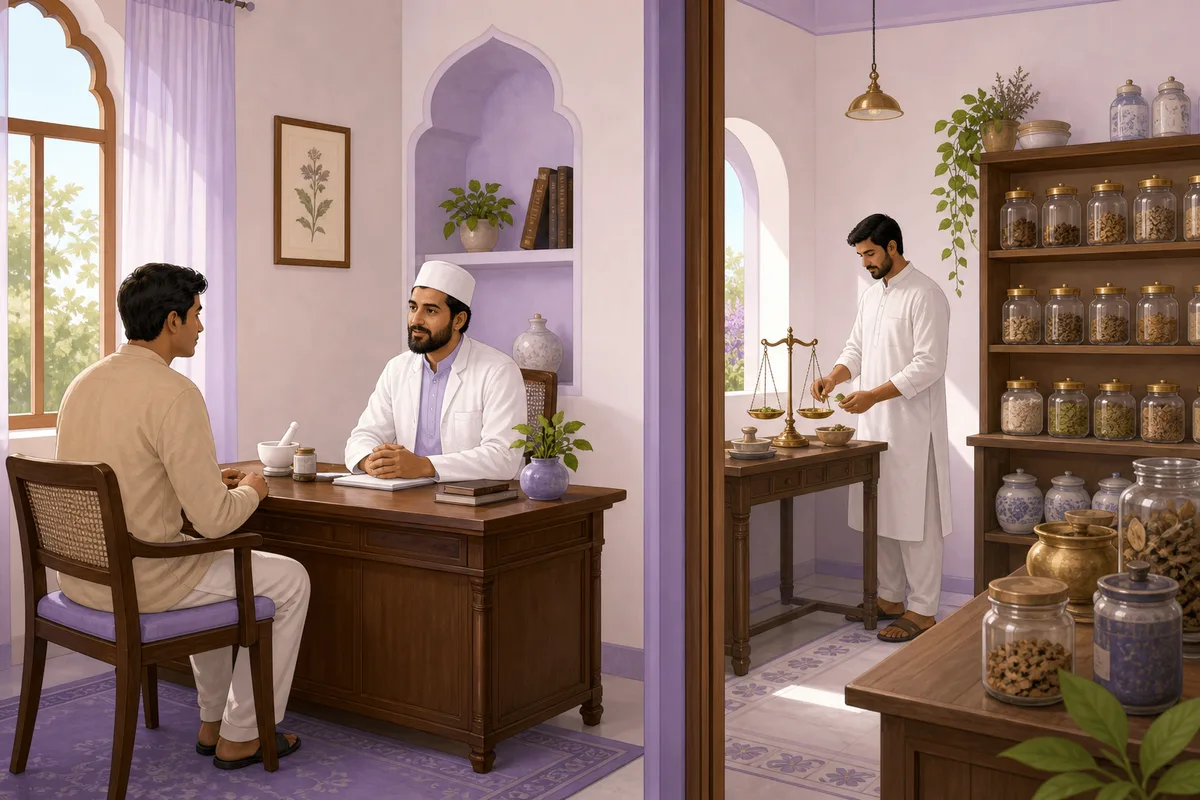
These are rough ranges, and they vary a lot by city. Buying second-hand furniture can halve them.
| Item | Must-have / Nice-to-have | Rough cost |
|---|---|---|
| Consultation desk, 3 chairs | Must-have | ₹10,000–₹25,000 |
| Examination couch with step stool | Must-have | ₹6,000–₹15,000 |
| BP apparatus, stethoscope, thermometer, weighing scale | Must-have | ₹4,000–₹10,000 |
| Privacy curtain and track | Must-have | ₹2,000–₹5,000 |
| Hijama couch (adjustable, washable) | Must-have if you do hijama | ₹8,000–₹25,000 |
| Disposable cupping sets, suction gun, sterile lancets or blades | Must-have if you do hijama | ₹3,000–₹8,000 starting stock |
| Colour-coded BMW bins (yellow, red, white sharps container) | Must-have | ₹2,000–₹5,000 |
| Hand-wash basin with elbow tap in the procedure room | Must-have | ₹5,000–₹15,000 |
| Medicine racks, dispensing counter, lockable cupboard | Must-have | ₹10,000–₹30,000 |
| Glass jars, measuring spoons, butter-paper or pouches for safoof | Must-have | ₹2,000–₹5,000 |
| Massage table and oil warmer for dalk | Nice-to-have | ₹8,000–₹20,000 |
| Steam unit (for inkebab / steam therapy) | Nice-to-have | ₹15,000–₹40,000 |
| Prescription printer | Nice-to-have | ₹6,000–₹15,000 |
The procedure room is about hygiene you can show. Patients judge a hijama practice by the floor, the bins and whether the cups come out of a sealed pack in front of them.
Your dawakhana and the hijama room
Start small and specific. Most hakeems find that 30 to 60 formulations cover the bulk of their prescriptions: digestive jawarish, khamira for the heart and mind, majoon for joints, sharbat for coughs, safoof and habb for everyday complaints, and a few roghan for external use. Buy those first. Add more only when you've had to send three patients elsewhere for the same thing.
Source carefully. Buy only from licensed manufacturers with clear labels and batch numbers, and ask for GMP certification. Some classical formulations contain ingredients that Schedule E(1) of the Drugs and Cosmetics Rules lists for special care in ASU medicines. Keep those labelled, separate and recorded. If you plan to compound your own preparations, joshanda mixes or custom safoof included, ask your state drug controller first what licence that needs. Don't assume.
Organise by form, then alphabetically. Majoon and khamira in one bay, sharbat in another, safoof jars together. Write the expiry month large on a sticker on each shelf front. Rotate stock so older batches go out first.
The hijama room is its own discipline. Hijama often becomes a Unani clinic's best-known service, and it carries the most operational risk. Things to settle before your first session:
- Single-use everything that touches blood. Cups, lancets and blades. Make sure patients see you open them.
- Waste segregation, done right every time. Under the BMW Rules 2016, blood-soiled cotton and dressings go in the yellow bag, contaminated disposable plastics like used cups go in red, and lancets and blades go in the white puncture-proof sharps container. Your CBWTF will tell you its collection schedule. Never let a bag wait in the waiting area.
- A written consent form for each procedure, signed and kept. Keep it plain-language, in the patient's language.
- A same-gender attendant for procedures where the patient wants one.
- A short aftercare sheet (rest, diet and when to call you) in Urdu, Hindi and English, so the patient goes home with it rather than half-remembering it.
Nimo tip: Print a small laminated card for the procedure room door with one line per bin: "Yellow: soiled cotton. Red: used cups and gloves. White box: sharps." New helpers learn segregation from what's in front of them, not from what you told them on day one.
How a consult flows
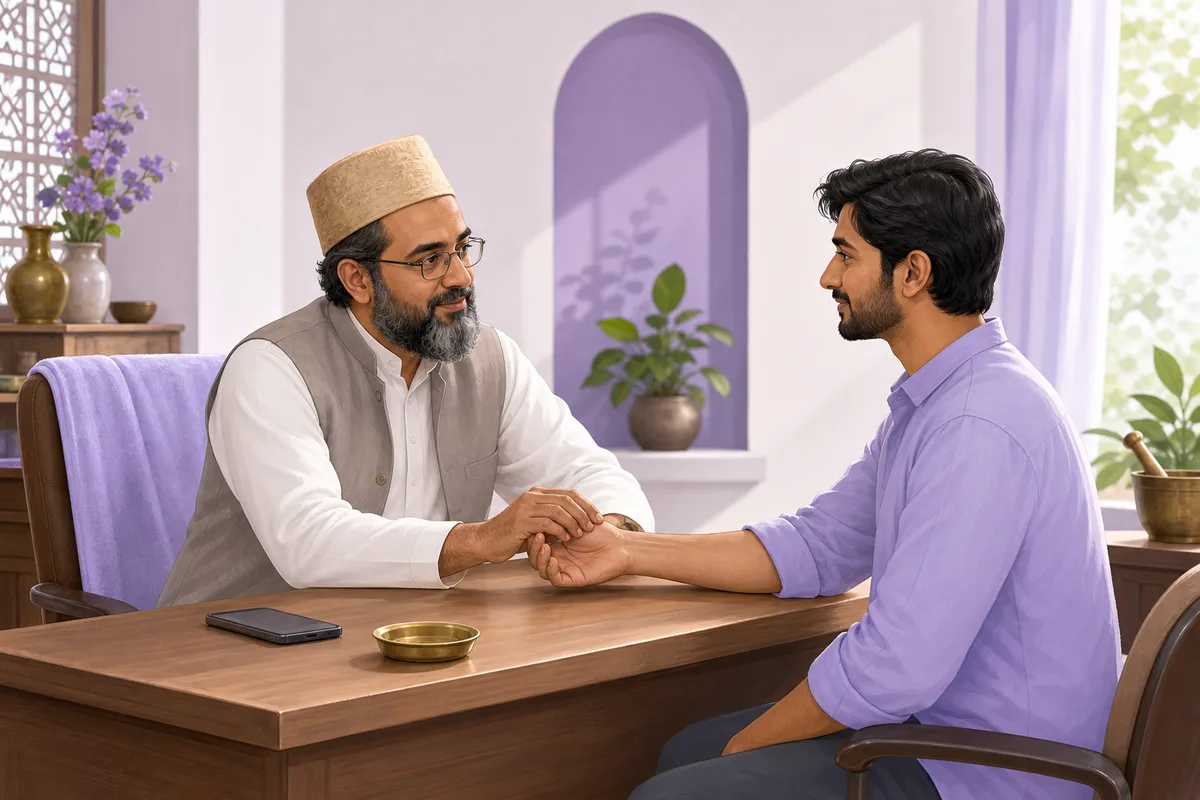
First visit (30–45 minutes). The patient registers at the desk. Your helper takes vitals and the basic history. Then you sit with them for the part only you can do: the complaint, the history, the nabz, and the questions that place their mizaj (damvi, balghami, safravi or saudavi). Then you go through the asbab-e-sitta zarooriya, the six essentials: air, food and drink, movement and rest, sleep and wakefulness, emotions, and retention and evacuation. Ask about baul and baraz. Agree on the plan, which usually blends ilaj-bil-ghiza (diet), ilaj-bil-tadbeer (regimen) and ilaj-bil-dawa (formulations). Write the prescription. The helper dispenses, explains doses and books the follow-up.
Follow-up (10–15 minutes). What changed, how the diet is going, whether the dose needs adjusting.
Hijama visit (45–60 minutes, room to room). This includes consent, preparation, the procedure, rest, aftercare advice and cleaning the room for the next patient. Don't book hijama back to back with no turnover time. The cleaning slot is the procedure's safety margin.
The front-desk handoff. Your helper should own four things: registration, vitals, dispensing against your written prescription, and booking the next visit before the patient leaves. You own the diagnosis, the prescription and the procedure. Write that split down in week one.
Pricing your consult
There's no single right number. Look at three things: what established hakeems in your area charge, what a local GP charges, and what your patients can comfortably pay every two weeks for six months. Unani care is a long arc, so a fee that feels fine once and painful the fifth time loses patients mid-course.
Rough ranges, which vary a lot by city:
| Service | Smaller towns | Metros |
|---|---|---|
| First consultation | ₹150–₹400 | ₹400–₹1,000 |
| Follow-up | ₹100–₹250 | ₹250–₹600 |
| Hijama session | ₹500–₹1,200 | ₹1,000–₹3,000 |
| Dalk or other tadbeer session | ₹300–₹800 | ₹600–₹1,500 |
Medicines. Price them separately from the consultation and openly, with the cost printed or written beside each formulation. Patients trust a hakeem who itemises. A "consultation including medicines" fee that changes visit to visit looks like guesswork.
Packages. A course of hijama sessions, or a month of regimen and follow-ups, can work well for chronic complaints. Keep packages simple, put them in writing, and refund unused sessions without argument. Your reputation is worth more than the balance.
For a fuller look at what setting up costs, see Clinic setup cost in India.
Your first 50 patients
Check your council's ethics code before you promote anything. The usual rule is to inform, not advertise: no claims of cures, no testimonials presented as guarantees, no "best hakeem in the city".
- Google Business Profile, done completely. Your name, qualification, timings, real photos of the clinic (not stock), and the services you offer, hijama included if you do it. Many patients search for "hijama near me" before they search for "Unani".
- A booking link you can share. When someone asks on WhatsApp "what time are you there?", send them a link where they can pick a slot themselves.
- Your old network. Batchmates, teachers and seniors from your BUMS college refer more than you'd expect, especially for patients who live in your area.
- The doctors around you. Introduce yourself to the local GP, physiotherapist and gynaecologist. Tell them clearly what you take on and what you send back. Doctors refer to people who refer back.
- Community talks. A 30-minute talk on diet and temperament at a residents' association, a women's group or a community hall, with free BP checks after. Leave behind your card, not a hard sell.
- Ramadan and seasonal rhythms. In many neighbourhoods, consultation timings around iftar, along with diet guidance for fasting patients, are genuinely useful. Patients remember the hakeem who adjusted for them.
Read more in How to get your first patients at a new clinic.
Records, notes and software
Paper, honestly. A good register and a case sheet per patient works on day one, costs nothing, and some patients find it reassuring. Paper starts to struggle around month four. That's when a patient returns asking for "the medicine you gave me last winter", and you need the formulation, the dose and the mizaj note. If you start on paper, use a structured format. Our free case sheet is a reasonable starting point.
Digital, honestly. Software only helps if it fits how you prescribe. Most clinic software is built around allopathic drug names and strengths, and typing "Majoon Suranjan, 5 g, BD after meals" into a "Brand / mg" box gets tiring fast.
Where Nimo fits. Nimo was shaped with Unani practice in mind:
- The prescription form uses Formulation and Dose fields, not brand-and-strength. Writing a safoof, majoon, sharbat or habb feels natural. Save your common protocols (your joint-pain regimen, your digestive starter) as templates and apply them in one tap. Prescriptions print with your name and clinic details.
- Patient history in one place. Mizaj notes, regimen advice, past formulations and vitals over time, searchable by name or phone number.
- Your helper sees the schedule, not the notes. Receptionists can register patients, record vitals and manage appointments. Clinical notes stay with doctors.
- A walk-in QR poster for your waiting room, and a booking link you share on WhatsApp.
The Free plan costs ₹0: 1 doctor, up to 100 visits a month, the booking link, walk-in QR, manual notes and prescriptions, and Google Calendar sync. You also get a free clinic website and booking page at gonimo.in/your-clinic-name. When you're busier, Pro (₹999/month or ₹9,999/year) adds up to 5 doctors, unlimited visits and auto visit notes: Nimo records the consultation, transcribes it and drafts the note for you to review.
If you'd like to see it first, try it here. When you're ready, start with Unani set up.
Opening-day checklist

- Registration certificate framed and visible
- Trade / establishment licence and clinical establishment registration (if your state requires it) on file
- CBWTF contract signed, and first collection date confirmed
- Yellow, red and white sharps bins in place, labelled, with liners
- Hijama consent form and aftercare sheet printed in your patients' languages
- Sealed cupping sets, lancets and gloves stocked for at least two weeks
- Dawakhana stocked, with expiry months marked on shelf fronts
- Price list for medicines and procedures written up and displayed
- BP apparatus, thermometer and scale checked against a known reading
- Walk-in QR poster on the wall at eye level
- Google Business Profile live, with correct timings and real photos
- Booking link tested by sending it to your own phone
- Prescription template for your five most common protocols saved
- Helper briefed: registration, vitals, dispensing and booking follow-ups
- Same-gender attendant arranged for procedure sessions
- First-aid kit and an emergency contact list (nearest hospital, ambulance) by the desk
- Your own lunch break blocked in the schedule
Things nobody tells you
The joshanda question will come on day one. Someone will ask you to "just make the decoction mix like the old hakeem used to". Decide your policy on compounding, and what licence it needs, before you open, so you can answer kindly and consistently.
Hijama demand comes in waves. Many patients prefer particular dates in the lunar month, so expect a crowd on those days and quiet ones in between. Open your procedure slots early for those dates. Don't try to squeeze six sessions into a room built for four.
Your mizaj note is your future self's best friend. Two lines on temperament at the first visit save you ten minutes six months later, when the same patient comes back with something new.
Grandmothers decide. In many families, the elder who brought the patient is the one who'll judge whether the regimen is followed. Explain the diet to them, not just to the patient.
Itemise, always. The fastest way to lose trust in a Unani practice is a medicine bill that feels like a number pulled from the air. Write it down, line by line.
Don't be the only Unani voice in your patient's life. Patients with diabetes, hypertension or pregnancy are often seeing an allopathic doctor too. Ask what else they're taking, write it down, and stay on good terms with that doctor. It's safer for the patient and good for referrals.
Where to go next
10 more chapters are waiting
Paperwork, the room, pricing, your first 50 patients, an opening-day checklist and the things nobody tells you. Tell us a little about you and Nimo opens them all.
General guidance, not legal or medical advice — rules differ by state, so confirm with your council and local body. More for new clinics in Resources.