
How to start a Siddha clinic: the Nimo playbook
Naadi, pathiyam and a clinic of your own, one calm step at a time.
- Typical space
- 200–350 sq ft
- Time to open
- 6–10 weeks
- Registers with
- State Indian medicine board / council
12 chapters · about 15 min read · updated
The 60-second version
- Siddha is a Tamil tradition, so your clinic should feel like one. Tamil-first signboards, case notes, pathiyam (diet) sheets and conversation. In most of Tamil Nadu, Puducherry and southern Kerala, that isn't decoration. It's how patients decide whether to trust you.
- Mornings are your best hours. Envagai thervu, especially neerkuri and neikuri on an early-morning urine sample, works best when new patients come in early. Build your timings around that.
- Registration varies by state. Tamil Nadu and Kerala each have their own clinical establishments laws, and practitioner registration sits with your state's Indian medicine board or council. NCISM maintains the central register. Ask early and keep copies of everything.
- Your marunthagam (dispensary) needs care. Parpam and chendooram are metal-mineral preparations, so buy them only from licensed manufacturers, with batch numbers you can trace.
- Give Varmam and Thokkanam a room of their own. Hands-on therapy builds loyalty faster than anything else, but it needs space, privacy and a washable surface for oils.
- The government Siddha wing down the road is part of your landscape. Patients can often get Siddha care free there, so your value is time, continuity and being reachable.
- Write the pathiyam down, every visit. Diet restrictions are where Siddha treatment succeeds or quietly fails. A spoken pathiyam is forgotten by the bus stop.
Before you sign a lease
Location. Siddha's heartland is Tamil Nadu, with strong roots in the south (Tirunelveli, Kanyakumari, Madurai), in Chennai, and in Puducherry, plus Thiruvananthapuram and the Tamil-speaking pockets of Kerala. In these places patients already know the system, and many will have heard of Siddha medical colleges or the National Institute of Siddha in Chennai. Outside them, expect your first year to go into explaining yourself.
Look for these signals on your walk-around:
- Country medicine shops (naatu marunthu kadai) and herbal stores nearby. They show demand, and they can become referral friends.
- Temple streets and old residential areas, where families visit for generations.
- Distance from the nearest government hospital with a Siddha wing. Too close, and you're competing with free. Two or three kilometres away, you're the convenient option.
Home clinic or rented space. A front-room clinic at home is common and perfectly respectable for a first Siddha practice, especially if you start in the mornings and evenings around another job. Check that your local body and your housing association allow it. Make sure oil therapy won't stain floors your family lives on.
Room count. Here's a workable small setup:
| Space | Purpose | Rough size |
|---|---|---|
| Waiting area | Chairs or a bench, drinking water, your QR poster, a Tamil health-message board | 50–80 sq ft |
| Consultation room | Desk, examination couch, good natural light for observing the tongue, eyes and skin | 80–120 sq ft |
| Therapy room | Varmam and Thokkanam: a massage table or floor mat, oil storage, wash basin | 60–100 sq ft |
| Marunthagam corner | Racks, a dispensing counter, a locked cupboard | 30–50 sq ft |
Natural light matters more than you'd think. Naa (tongue), niram (colour) and vizhi (eyes) are all part of your examination, and a tube light in a windowless room makes everyone look the same shade.
Paperwork and registrations
Rules differ by state and change over time. Treat this list as what to ask about, then confirm each item with your state board or council and your local body.
| What | Who issues it | When |
|---|---|---|
| Practitioner registration (BSMS or equivalent) | Your state's board or council for Siddha / Indian systems of medicine. NCISM maintains the central register | Before you see a single patient |
| Clinical establishment registration | Tamil Nadu and Kerala each have their own state laws for registering clinical establishments, rather than relying only on the central Clinical Establishments Act 2010. Ask your district health office (TN) or the state clinical establishments authority (Kerala). Puducherry: ask the UT health department which framework applies | Before opening |
| Trade licence / Shops & Establishment registration | Corporation, municipality or panchayat | Before opening |
| Bio-medical waste authorisation and a CBWTF tie-up | State Pollution Control Board, under the Bio-Medical Waste Management Rules 2016, plus a contract with your nearest Common Bio-medical Waste Treatment Facility | Before opening. Even a clinic without procedures produces gloves, cotton and occasional sharps |
| Fire NOC | Fire and Rescue Services. Whether you need one depends on building size and type, and the thresholds vary | Ask when you sign the lease |
| Signboard | Local body for the board. Your council's ethics code for what it says. In Tamil Nadu, also check the current rules on Tamil lettering on boards | Before you put it up |
| GST | Healthcare services by clinical establishments are generally exempt. Medicine sales may be treated differently, so confirm with a CA | At setup |
| Drug licence questions | State drug controller (Indian medicine wing). Ask whether dispensing to your own patients, retail sales and preparing your own medicines each need something different | Before stocking |
Nimo tip: Ask for every receipt and acknowledgement as you apply, not just the final certificate. Offices in all three states move at their own pace, and "applied on this date, here is the receipt" is what keeps an inspection conversation calm while you wait.
For the general picture across specialties, see Clinic registration and licences in India.
Setting up the room
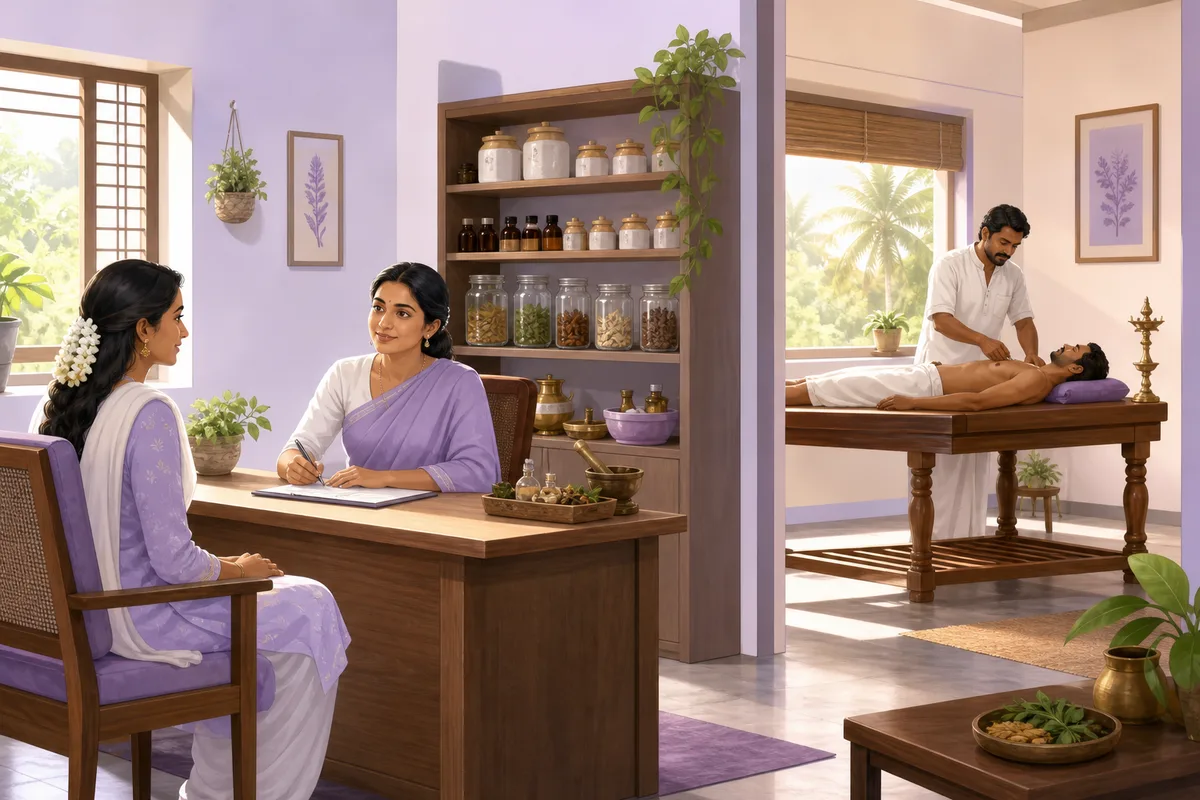
These are rough ranges, and they vary a lot by town. A carpenter-built rack costs a fraction of a branded one.
| Item | Must-have / Nice-to-have | Rough cost |
|---|---|---|
| Consultation desk, 3 chairs | Must-have | ₹8,000–₹20,000 |
| Examination couch with step stool | Must-have | ₹6,000–₹15,000 |
| BP apparatus, stethoscope, thermometer, weighing scale | Must-have | ₹4,000–₹10,000 |
| Good lighting (a window, or a daylight-temperature lamp) | Must-have | ₹1,500–₹5,000 |
| Clean glass or white dishes, droppers, sample containers for neerkuri / neikuri | Must-have | ₹1,000–₹3,000 |
| Massage table or firm floor mat for Varmam and Thokkanam | Must-have if you offer them | ₹5,000–₹20,000 |
| Oil warmer, steel oil vessels, washable sheets and towels | Must-have for therapy | ₹3,000–₹8,000 |
| Wash basin in the therapy room | Must-have for therapy | ₹4,000–₹12,000 |
| Medicine racks, dispensing counter, lockable cupboard | Must-have | ₹10,000–₹25,000 |
| Glass jars, measuring spoons, pouches for chooranam | Must-have | ₹2,000–₹5,000 |
| Colour-coded BMW bins with liners | Must-have | ₹1,500–₹4,000 |
| Steam / fomentation setup (for vedhu or ottradam) | Nice-to-have | ₹10,000–₹30,000 |
| Prescription printer | Nice-to-have | ₹6,000–₹15,000 |
The therapy room will smell of oil within a week, and that's fine. What you need to watch is the floor. Choose a non-slip, washable surface, and keep a mop by the door. An older patient slipping on oil is the most avoidable accident in a Siddha clinic.
Stocking your marunthagam
Start with what you actually prescribe. Siddha has a rich range of forms: the classical 32 internal and 32 external medicines. A new clinic doesn't need most of them on the shelf. Begin with the chooranam, kudineer, mathirai, lehyam (ilagam), nei, thailam and manapagu you used most during your internship. Add a carefully chosen handful of parpam and chendooram, plus the external oils you use for Thokkanam and Varmam. Many practitioners find 40 to 70 items cover most of their prescriptions.
Metal-mineral preparations deserve extra care. Parpam, chendooram and similar preparations are among Siddha's distinctive strengths. Some contain ingredients listed in Schedule E(1) of the Drugs and Cosmetics Rules for special handling in ASU medicines. Buy them only from licensed manufacturers, with clear labels and batch numbers. In Tamil Nadu, government-run and co-operative suppliers such as TAMPCOL and IMPCOPS are long-standing options alongside private GMP-certified makers. Keep these preparations on a separate labelled shelf and record the batch you dispensed against each patient. If you prepare anything yourself, even a simple chooranam blend, ask your state drug controller first what licence that requires.
Kudineer is a logistics question. Patients usually take decoction powders home to boil. Decide in advance whether you dispense in pre-weighed daily pouches (more work for you, far better adherence) or as a loose quantity with a measuring spoon. Then write the preparation steps in Tamil on the pouch or a slip: how much water, reduced to how much, taken when.
Expect seasonal surges. During the monsoon fever season, demand for familiar kudineers rises sharply, and patients will walk in asking for them by name. Keep a buffer stock before the rains, not after.
The pathiyam sheet belongs to the dispensary too. Many Siddha medicines come with pathiyam (diet rules) and apathiyam (what to avoid). Print a few standard sheets in Tamil, one per common regimen, so your helper can hand over the right one with the medicines. Then add any patient-specific changes by hand.
Nimo tip: Mark a big expiry month on the front edge of each shelf, and do a 15-minute expiry walk on the first Monday of every month. Thailam and lehyam don't look expired until a patient complains.
How a consult flows
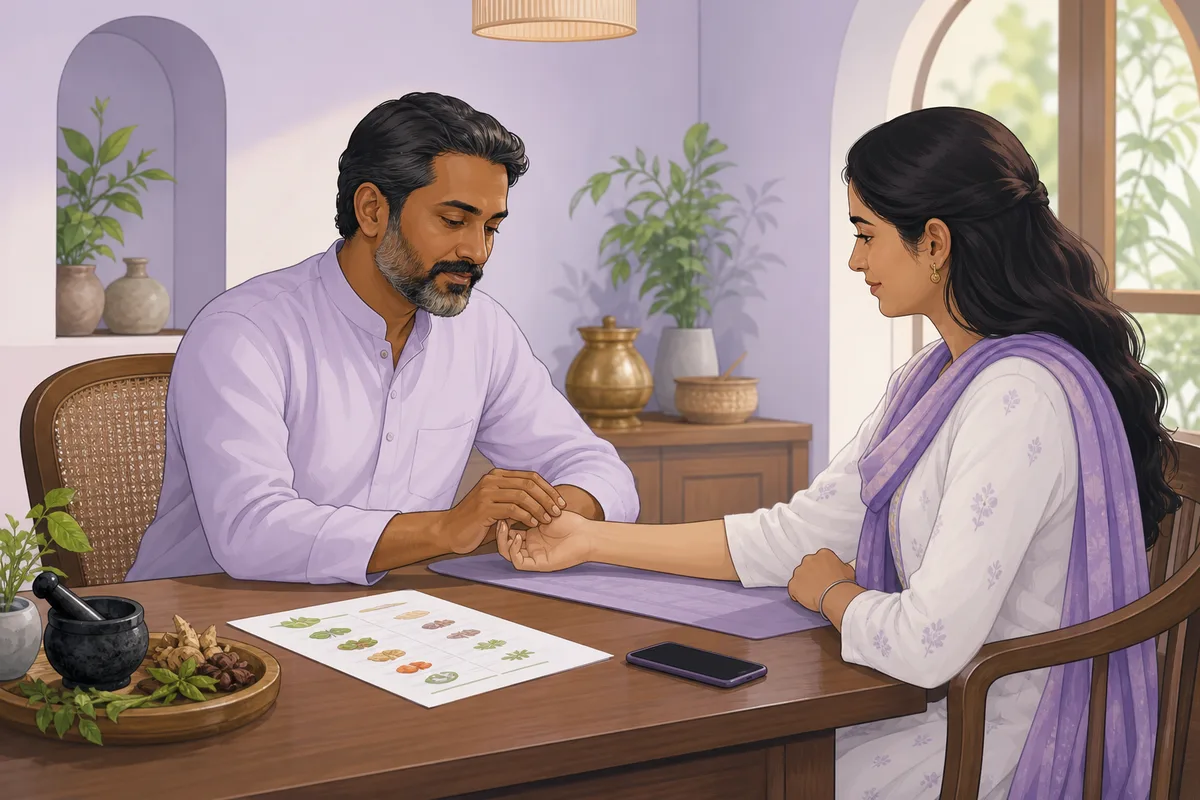
First visit (30–45 minutes, ideally in the morning). Ask new patients to come early and, where you use neerkuri and neikuri, to bring a first-morning urine sample in a clean container. Tell them this clearly when they book. Your helper registers them and takes vitals. Then comes the part only you can do: the complaint and history, the envagai thervu (naadi, sparisam, naa, niram, mozhi, vizhi, malam, moothiram), and placing the imbalance in vatham, pitham and kabam. After that, you explain the plan in plain Tamil and write the prescription and pathiyam. The helper dispenses, explains how to prepare each medicine, hands over the pathiyam sheet and books the follow-up.
Follow-up (10–15 minutes). How the patient has responded, whether the pathiyam is being followed, and whether the dose or medicine needs changing. Ask about the pathiyam directly. Patients rarely volunteer that they stopped.
Varmam or Thokkanam session (30–60 minutes). Allow for changing, the session itself, rest and cleaning the room. Keep a same-gender attendant available, and record which points or areas you treated, so the next session builds on the last.
The front-desk handoff. Your helper owns registration, vitals, dispensing against your written prescription, explaining preparation, the pathiyam sheet and the next booking. You own the assessment, the prescription and the therapy. Write that split on one page in week one.
Pricing your consult
Start with your local reality. What do other private Siddha practitioners nearby charge? What does the local GP charge? And what do patients get free at the government Siddha wing? You're not competing on price. You're offering time, continuity, easy timings and someone who remembers them.
Rough ranges, which vary a lot by place:
| Service | Towns and rural areas | Chennai / larger cities |
|---|---|---|
| First consultation | ₹100–₹300 | ₹300–₹800 |
| Follow-up | ₹50–₹200 | ₹200–₹500 |
| Varmam session | ₹200–₹600 | ₹500–₹1,500 |
| Thokkanam session | ₹300–₹800 | ₹700–₹2,000 |
Charge for medicines separately and openly. Write the cost of each item on the bill. Many Siddha patients have, at some point, been handed an unlabelled packet and a single total, so an itemised bill builds trust quickly.
Packages. A series of Varmam sessions or a month's course with follow-ups can work well for long-standing pain or chronic complaints. Keep the terms in writing, in Tamil, and refund unused sessions without fuss.
For the cost side of the equation, see Clinic setup cost in India.
Your first 50 patients
Read your council's ethics code before promoting anything. The general rule is to inform, never advertise cures. No guarantees, no "permanent cure" language, no before-and-after claims.
- Google Business Profile, in Tamil and English. List your qualification, morning and evening timings, the services you offer (Varmam, Thokkanam) and real photos. Many patients search in Tamil, so describe your services the way they'd say them.
- A booking link on WhatsApp. When someone asks "naalaikku eppo varalaam?" (when can I come tomorrow?), send a link where they choose a slot. Mention the morning sample in your reply.
- Your college network. Batchmates and teachers from your Siddha medical college refer patients to people they trust, especially across districts.
- Naatu marunthu shops and yoga teachers nearby. They meet people who need a proper consultation. Introduce yourself, and be clear about what you'll send back to them and what you won't.
- Local doctors. The GP, the physiotherapist, the diabetologist. Tell them what you offer and that you'll keep them informed about shared patients.
- Talks, not camps-for-show. A talk on seasonal food and pathiyam at a temple hall, school or residents' association, followed by free BP checks, builds more than a camp you can't follow up on.
- National Siddha Day. It's celebrated each year, usually in December or January (the Tamil month of Margazhi), and it's a natural moment for a free awareness talk or an open morning.
Read more in How to get your first patients at a new clinic.
Records, notes and software
Paper, honestly. A case sheet per patient and a daily register cost almost nothing and work on day one. Where paper struggles is the long arc. A patient returns after eight months and asks for "the chooranam that worked last time", and you need to know which one, what dose, which batch of chendooram, and what pathiyam they were on. If you start on paper, use a structured format. Our free case sheet is a good base.
Digital, honestly. Most clinic software assumes allopathic drug names and milligram strengths. That makes "Nilavembu kudineer, 60 ml, BD before food" an awkward fit.
Where Nimo fits. Nimo was shaped with Siddha practice in mind:
- The prescription form uses Formulation and Dose fields, not brand-and-strength, so writing a chooranam, chendooram, parpam or mezhugu feels natural. Save your common protocols as templates, apply them in one tap, and print the prescription with your name and clinic details.
- The whole story in one place. Envagai thervu findings, pathiyam advice, past formulations and vitals over time, searchable by name or phone number.
- Your helper sees appointments and vitals, not your notes. Clinical notes stay with doctors.
- A walk-in QR poster for the waiting room, and a booking link you share on WhatsApp.
The Free plan costs ₹0: 1 doctor, up to 100 visits a month, the booking link, walk-in QR, manual notes and prescriptions, and Google Calendar sync. You also get a free clinic website and booking page at gonimo.in/your-clinic-name. When you're busier, Pro (₹999/month or ₹9,999/year) adds up to 5 doctors, unlimited visits and auto visit notes: Nimo records the consultation, transcribes it and drafts the note for you to review. If you consult mostly in Tamil, try it on a few real consultations before you rely on it.
You can try it here first. When you're ready, start with Siddha set up.
Opening-day checklist
- Registration certificate framed and displayed
- Clinical establishment registration (or its acknowledgement receipt) and trade licence on file
- CBWTF contract signed, and collection day confirmed
- Colour-coded bins in place with liners
- Signboard up, with Tamil lettering checked against local rules
- Marunthagam stocked, with expiry months marked on shelf fronts
- Parpam and chendooram on a separate labelled shelf, with batch numbers recorded
- Kudineer pouches or measuring spoons ready, with Tamil preparation slips
- Pathiyam sheets printed in Tamil for your common regimens
- Clean containers and dishes ready for neerkuri / neikuri
- Therapy room floor checked for slip risk, with a mop and towels at hand
- Medicine and therapy price list displayed
- Walk-in QR poster at eye level in the waiting area
- Google Business Profile live in Tamil and English, with correct timings
- Booking link tested on your own phone
- Helper briefed: registration, vitals, dispensing, pathiyam handover and follow-up booking
- First-aid kit and nearest-hospital number by the desk
- A real lunch break blocked in your schedule
Things nobody tells you
The sample conversation is awkward. Have it anyway. Telling a new patient to bring a morning urine sample feels odd the first ten times. Say it warmly at booking and they'll arrive prepared. Forget, and your first envagai thervu is missing a piece.
"Free at the government hospital" isn't your enemy. Patients who come to you have chosen time and attention over a queue. Give them both, generously, and they'll stay for years.
The patient is following half the pathiyam. Assume it, ask gently, and find the half they can manage. A realistic pathiyam that's actually followed beats a perfect one that isn't.
Your Tamil is part of your treatment. Patients judge competence partly by how naturally you explain vatham, pitham and kabam in their words. Practise the plain-Tamil version of your common explanations.
Know your parpam's paperwork. One day a patient or another doctor will ask what's in it and where it came from. Being able to show the manufacturer, the batch and the label in a minute is the end of that conversation.
The monsoon will test your stock. Fever-season demand arrives fast. Order before the rains and you're the clinic that had it.
Where to go next
10 more chapters are waiting
Paperwork, the room, pricing, your first 50 patients, an opening-day checklist and the things nobody tells you. Tell us a little about you and Nimo opens them all.
General guidance, not legal or medical advice — rules differ by state, so confirm with your council and local body. More for new clinics in Resources.