

How to start a physiotherapy clinic: the Nimo playbook
Plinths, patience and a schedule that fills itself.
- Typical space
- 400–800 sq ft
- Time to open
- 6–12 weeks
- Registers with
- State physio council, where one exists
12 chapters · about 16 min read · updated
The 60-second version
- Physiotherapy is a course of care, not a one-off consult. Your clinic's real product is the patient who finishes all ten sessions, not the one who comes once.
- Location matters more than décor. Ground floor or a working lift, parking nearby, and a short walk from orthopaedic surgeons, GPs and gyms who will send you patients.
- Paperwork is lighter than for a medical clinic, but not nothing: professional registration (where your state has a physio council), clinical-establishment registration where your state has adopted the Act, and a local trade or Shops & Establishment licence.
- You can open with two plinths, an IFT/TENS combo unit, a therapeutic ultrasound, hot packs and a good exercise corner. Traction, laser and SWD can wait until your caseload tells you what it needs.
- Price per session, then build packages that match a realistic plan (say 6 or 10 sessions). Packages protect outcomes as much as revenue.
- Your first 50 patients come from referral doctors, a Google Business Profile and a booking link that makes the next session easy to book.
- Keep notes that show progress across sessions: pain scores, range of motion, functional goals and the home programme you gave.
Before you sign a lease
Ground floor or a lift, always. Your patients include a 70-year-old post knee replacement, a man with acute low back pain who can barely sit in a car, and a teenager on crutches after an ACL repair. A second-floor walk-up quietly turns away half your referrals. Check the approach too: a ramp or one low step, a wide door (a wheelchair needs roughly 32–36 inches), and somewhere a car can stop right outside.
Count treatment spaces, not rooms. A small physio clinic is mostly one open floor:
- A reception and waiting area with firm, high chairs (low sofas are a trap for hip and knee patients).
- A treatment area with two to four plinths separated by curtains or partitions.
- An exercise and gait area: open floor, a long mirror, parallel bars later, and enough length (around 6–8 metres) to watch someone walk.
- One closed cubicle or room for assessments that need privacy: pelvic health, women patients who prefer a closed space, and anyone being examined with less clothing.
- An accessible toilet, ideally with a grab rail.
Something around 400–800 sq ft covers a two-plinth start with room to grow. A home clinic can work for a solo practitioner if it has its own entrance and a clean, separate treatment room, but check your housing society and local body rules on running a clinic from a residence first.
Neighbourhood fit for physio:
- Near referrers. Orthopaedic clinics, a small nursing home, a sports academy, a GP with a busy OPD. A five-minute drive for patients is fine; a five-minute walk for a referral slip is better.
- Near gyms, running groups and offices if you want sports and desk-posture work.
- Near older residential areas if your interest is neuro rehab, geriatrics or post-operative care, where many patients will also want home visits.
- Evening footfall. Working patients come before 10 am and after 5 pm. A location that is dead in the evenings will fight you.
Electricity. Electrotherapy, a hydrocollator and air-conditioning add up. Ask about the sanctioned load before you sign.
Paperwork and registrations
Rules differ by state and change over time, so treat this as a list of what to ask about, not legal advice. Confirm each item with your state council, your local body and, for tax, a chartered accountant.
| What | Who issues it | When |
|---|---|---|
| Professional registration as a physiotherapist | Your state physiotherapy council or allied-health council, where one exists | Before you treat your first patient |
| Clinical establishment registration | State or district registering authority, in states that have adopted the Clinical Establishments (Registration and Regulation) Act 2010 or have their own law | Before opening; ask whether a physio-only clinic is covered in your state |
| Shops & Establishment registration or trade licence | Municipal corporation or local body | Before opening |
| Signboard permission | Local body (size and placement rules vary) | Before putting it up |
| Bio-medical waste arrangement | A Common Bio-medical Waste Treatment Facility, under the Bio-Medical Waste Management Rules 2016 | Only if you generate it, for example if you do dry needling |
| Fire NOC | Fire department | Only if your premises cross your state's threshold; ask |
| GST registration | GST department | Ask a CA. Healthcare services by clinical establishments are generally exempt, but product sales (braces, supports, equipment) may not be |
| Professional indemnity insurance | Any general insurer | Before opening; not always mandatory, always sensible |
A few things worth knowing:
- Allied-health regulation is still settling. The National Commission for Allied and Healthcare Professions Act 2021 recognises physiotherapy as an allied healthcare profession and sets up national and state councils, but how far your state has got with its council varies. Some states already have their own physiotherapy council and registration. Ask locally what applies to you today.
- The referral question. Whether you can see patients directly or need a doctor's referral, and what you can write on a referral note, are questions to ask your state council and your professional association. Good practice either way: when you suspect something outside physiotherapy, refer back promptly and write it down.
- Titles and signboards. Use the qualification you hold (BPT, MPT and specialisation) and your registration number if your council issues one. Avoid claims like "cure guaranteed" or "painless in one session". Your council or association ethics code is the place to check.
Nimo tip: Keep a single folder, paper or digital, with every certificate, licence and renewal date. Most renewals fall in the first quarter of the financial year, and missing one is a far bigger headache than renewing it.
Setting up the room
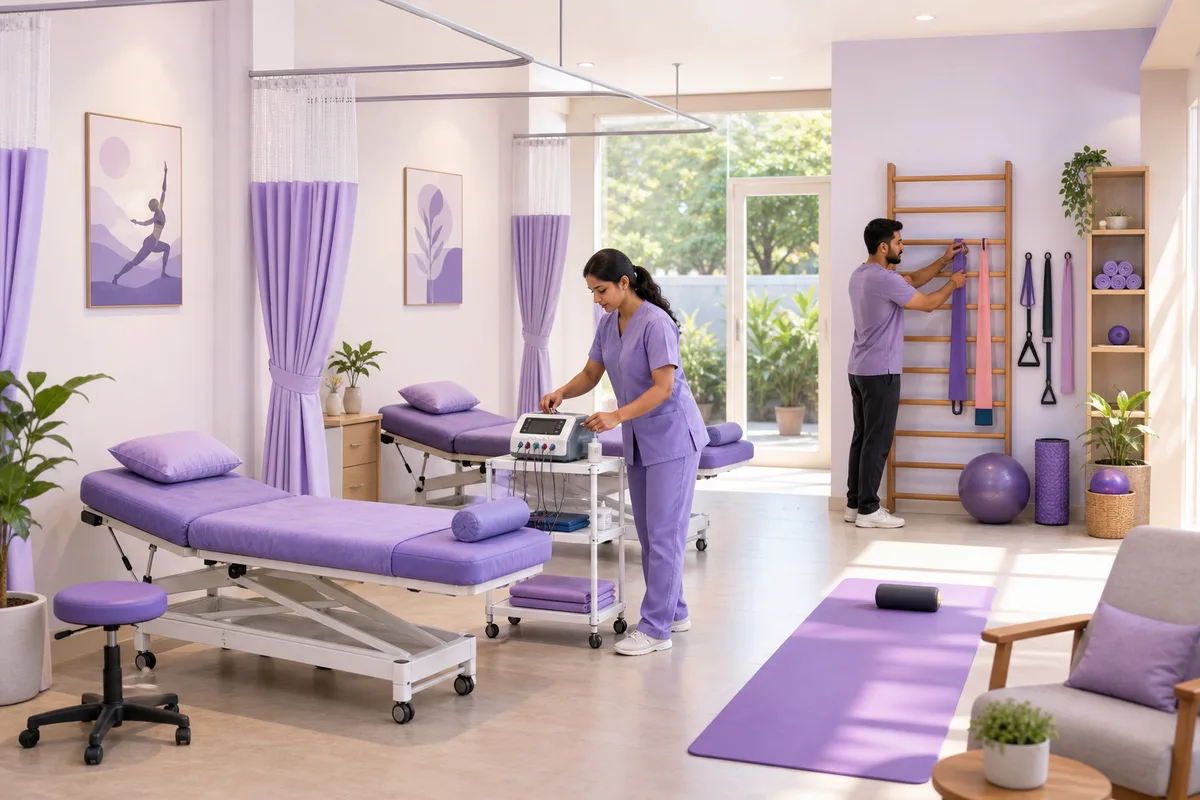
Rough ranges only. They vary a lot by city, brand, and whether you buy new or refurbished.
| Item | Must-have / Nice-to-have | Rough cost |
|---|---|---|
| Treatment plinths (2), ideally one height-adjustable | Must-have | ₹8,000–₹25,000 each; electric hi-lo ₹40,000+ |
| IFT/TENS combination unit | Must-have | ₹15,000–₹60,000 |
| Therapeutic ultrasound | Must-have | ₹15,000–₹50,000 |
| Hydrocollator with hot packs, plus cold packs | Must-have | ₹10,000–₹30,000 |
| Assessment kit: goniometer, measuring tape, reflex hammer, pain scale charts | Must-have | ₹2,000–₹6,000 |
| Exercise kit: dumbbells, ankle weights, Theraband set, Swiss ball, wobble board, mat, step | Must-have | ₹8,000–₹20,000 |
| Full-length mirror for posture and gait | Must-have | ₹3,000–₹10,000 |
| Pillows, wedges, bolsters, washable covers, towels | Must-have | ₹3,000–₹8,000 |
| Curtains or partitions between plinths | Must-have | ₹5,000–₹20,000 |
| Stabiliser or UPS for electrotherapy | Must-have | ₹5,000–₹20,000 |
| Lumbar and cervical traction unit | Nice-to-have | ₹40,000–₹1,50,000 |
| Parallel bars and a static cycle | Nice-to-have | ₹15,000–₹60,000 |
| Shortwave diathermy or low-level laser | Nice-to-have | ₹40,000–₹2,00,000+ |
| Muscle stimulator for neuro rehab | Nice-to-have | ₹15,000–₹50,000 |
| CPM machine for post-op knees | Nice-to-have | ₹40,000–₹1,00,000 |
Buy electrotherapy from a dealer who services it locally. A broken IFT unit with a three-week repair queue costs more in cancelled sessions than you saved on the price.
Your treatment floor
The treatment floor is where a physio clinic either flows or jams. Plan it like a timetable, not a showroom.
Think in stations, not plinths. A typical session moves through three places: a plinth for assessment and manual therapy, a modality slot (hot pack, IFT or ultrasound running for 10–15 minutes), and the exercise area. If all three happen on the same plinth, that plinth is blocked for 45 minutes. If the patient moves from a modality plinth to the exercise corner, you can overlap two or three patients without anyone feeling rushed.
Overlap carefully. It is common, and reasonable, to have one patient on IFT while you start another's assessment. It is not reasonable to leave a patient unattended on a hot pack and forget them. Use a simple kitchen timer per plinth, or the timer on the unit, and never leave a patient on heat without checking the skin.
Hygiene that patients notice:
- Fresh paper roll or a clean sheet on every plinth, every patient.
- Wipe down handles, Swiss balls and dumbbells daily, and plinth surfaces between patients.
- Ultrasound gel wiped off, transducer cleaned, IFT pads replaced on schedule (worn pads give uneven current and unhappy patients).
- Hot pack covers washed often. A stale hydrocollator smell is the first thing a new patient notices.
Safety basics. A first-aid kit, a blood pressure monitor and a glucometer for older patients, a clear route to the door, and a written note of the nearest hospital. Know the contraindications for each modality you use, and screen for them at the first visit (pacemakers, pregnancy, impaired sensation, metal implants near the site).
Home visits. Many clinics run a parallel home-visit service for post-operative and neuro patients. If you do, keep a portable kit (a portable TENS, Therabands, a goniometer) and block home visits into a fixed part of the day so they do not eat your clinic hours.
Nimo tip: Draw your floor on paper at 1 cm = 30 cm before buying anything. Mark where the plug points are. Most clinics discover their electrotherapy unit and the only socket are on opposite walls.
How a consult flows
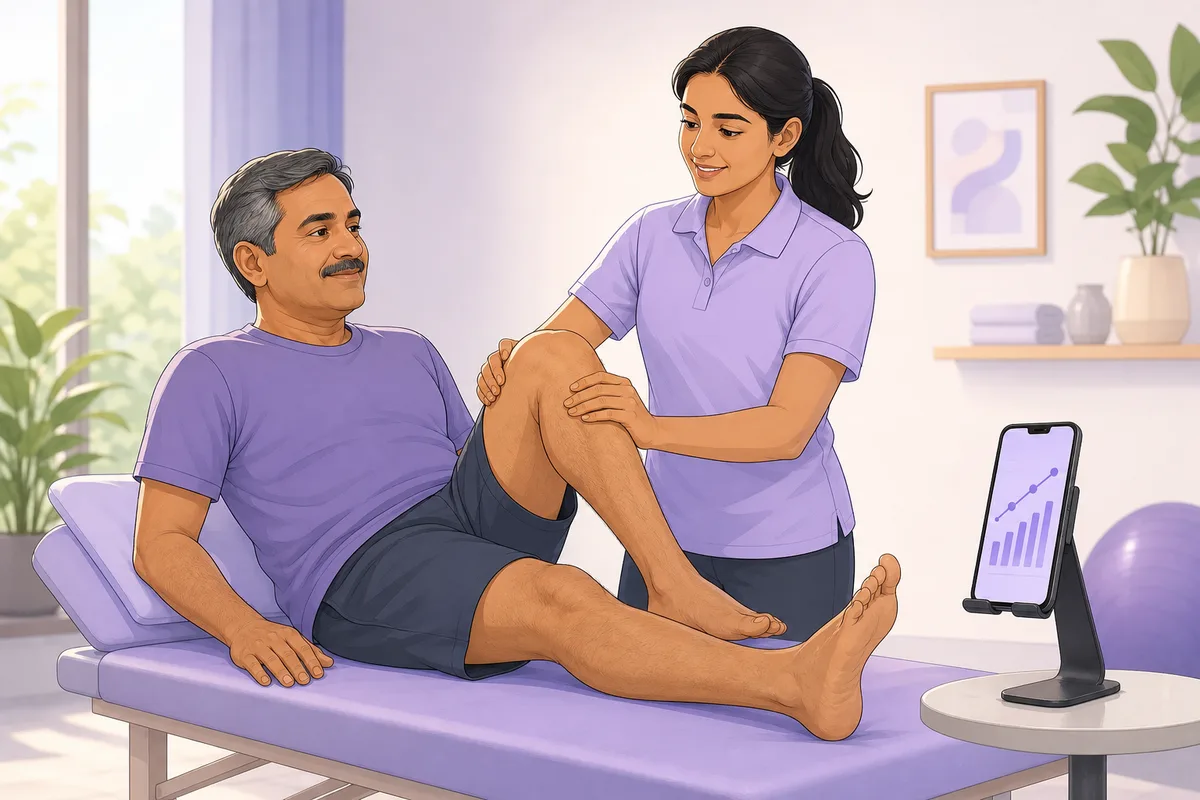
First visit: 45–60 minutes.
- Front desk (5 minutes). Name, mobile, age, the referring doctor if any, and any reports or scans the patient brought. Ask them to bring X-rays and MRI reports to the first visit, every time.
- Subjective assessment (10–15 minutes). History of the complaint, pain on a 0–10 scale, aggravating and easing factors, red flags, past surgeries, what the patient wants to get back to doing.
- Objective assessment (15–20 minutes). Observation, range of motion, strength, special tests, gait, function.
- Plan (5–10 minutes). Explain what you found in plain words, agree goals ("climb the stairs at home without the railing in four weeks"), and agree a number of sessions.
- First treatment and home programme (10–15 minutes). Usually a modality or manual therapy, and two or three home exercises the patient can actually remember.
- Back to the desk. Book the next session before they leave. This is the single most important handoff in a physio clinic.
Follow-up session: 30–45 minutes. A quick check-in (pain, what improved, whether they did the exercises), treatment, progression of the exercise plan, and a short note. Re-assess formally every few sessions, around session 5 and at discharge, so you and the patient can both see progress.
At the front desk, the helper should be able to see who is on which plinth, who is waiting, and who has not booked their next session yet. If you are solo, that "helper" is you, between patients.
Pricing your consult
There is no single right price. Look at what nearby physiotherapists charge, what the orthopaedic surgeons in your area charge for a consult, and what your patients can sustain for a full course of care. These are rough ranges and vary a lot by city:
| Service | Rough range |
|---|---|
| First assessment with treatment | ₹500–₹1,500 |
| Follow-up session, clinic | ₹400–₹1,000 |
| Home visit | ₹600–₹1,500, plus travel in larger cities |
| Specialised sessions (sports, neuro, pelvic health) | Often at the upper end or above |
Packages are where physio pricing gets sensible. A plan of 6 or 10 sessions at a small discount does three things: it signals that recovery takes a course of care, it reduces "I feel a bit better, I'll stop" drop-offs, and it smooths your cash flow. Keep packages honest: valid for a sensible window, clear about what happens if the patient needs fewer sessions, and never sold to someone who does not need that many.
Write your prices on a small board at the desk. Patients should never be surprised at the end of a session.
Your first 50 patients
Physiotherapy grows on referrals and results. Most of your first 50 patients will come from five places:
- Referral doctors. Visit orthopaedic surgeons, GPs, neurologists and gynaecologists nearby. Take a one-page note: who you are, what you treat, your timings, and that you will send a short progress note back. Then actually send it. A surgeon who hears back about their post-op knee will send you the next one.
- Google Business Profile. Set it up the week you open, with the correct pin, timings, photos of your treatment floor (no patients in them) and your phone number. Ask happy patients for a review; never write or buy them.
- A booking link. Put your clinic's booking link on your Google profile, your signboard QR code and your WhatsApp status. Patients rebooking their next session at 10 pm is a good problem to have.
- Talks and camps. A free posture talk at an IT office, a knee-pain session at a senior citizens' association, a warm-up workshop for a running club. Teach, do not sell, and keep it within your council's or association's guidance on advertising.
- Your own patients. Someone who walks again without a stick tells their whole building. Give them a card to pass on.
Avoid before-and-after claims, "100% cure" language and paying commissions for referrals. They cheapen the practice and can break ethics rules.
Records, notes and software
Paper works, honestly, for the first few weeks. A printed assessment form, a session log per patient and a register at the desk will see you through. The trouble arrives around patient 40: you are hunting for a file while the patient waits, you cannot remember which exercises you progressed last Tuesday, and the surgeon calls asking how their patient is doing.
Whatever you use, good physio records show:
- Baseline and change: pain scores, range of motion in degrees, strength grades, functional goals.
- What you did each session: modalities and parameters, manual therapy, exercises with sets and reps.
- The home programme you gave, so you can progress it rather than restart it.
- Re-assessment and discharge, with the outcome in a line or two.
A simple structure like SOAP (subjective, objective, assessment, plan) keeps notes short and consistent. If you want a template, our free SOAP note format is a good place to start.
Where Nimo fits. Nimo was built for small clinics like yours, and for physiotherapy it is set up around a course of care rather than a prescription pad. You keep treatment-plan notes (assessment, goals and exercises) and progress them across sessions, with every session in the patient's timeline. There is an illustrated exercise library that pre-fills sets and reps, and a home programme you can print or share to the patient's phone. Patients book and rebook from your own booking page at gonimo.in/your-clinic-name, which also gives you a free clinic website, and a walk-in QR poster lets new patients register from their own phone.
The Free plan is ₹0: one practitioner, up to 100 visits a month, booking link, walk-in QR, manual notes and Google Calendar sync. When the floor gets busy, Pro (₹999/month or ₹9,999/year) adds up to five practitioners, unlimited visits, and visit notes Nimo drafts for you: it records the assessment, transcribes it and drafts the note while you stay hands-on. You review and finalise. If that sounds useful, you can set up a physiotherapy practice in a few minutes.
Opening-day checklist

- Registration certificate and qualifications framed or ready to show
- Clinical establishment and local body registrations in hand, or applied for as your state requires
- Every plinth with a clean sheet or paper roll, pillows and towels stocked
- IFT/TENS, ultrasound and hydrocollator tested, pads and gel in stock
- Timer for each plinth that uses a modality
- Exercise corner set up, mirror fixed, weights and bands sorted by resistance
- Privacy cubicle or room ready, with a chaperone arrangement for sensitive assessments
- First-aid kit, BP monitor and glucometer at hand
- Nearest hospital and ambulance number written at the desk
- Price board at the desk, including packages
- Assessment forms (paper or digital) ready, with a consent line for treatment
- Booking link live and tested from a patient's phone
- Google Business Profile verified, with timings and photos
- Walk-in QR or registration form at reception
- One-page referral note printed for nearby doctors
- UPI QR and a receipt book or billing set up
- Toilet clean, grab rail fixed, path to the door clear
- Your own lunch break blocked on the schedule
Things nobody tells you
Things nobody tells you: Your hardest job is not treatment. It is getting a patient from session 3 to session 8. Pain eases early, life gets busy, and the course quietly stops. Book the next session before they leave, every single time.
- The hydrocollator is your morning alarm. It needs time to heat. Switch it on when you arrive, not when your first patient does.
- Your back is part of the business. Physiotherapists hurt themselves doing manual therapy on a plinth that is too low. Buy one height-adjustable plinth early, and use it.
- Home exercise programmes fail on paper scraps. Three exercises the patient understands beat ten they do not. Show them, watch them do it, and give them something with pictures.
- Write back to referring doctors. Three lines after the assessment and three at discharge. It is the cheapest marketing you will ever do, and the most respected.
- Do not buy the laser in month one. Let six months of caseload tell you whether you need traction, SWD or a laser. Many clinics never use the expensive machine they bought for the opening photo.
- Discharge is a skill. Patients who are ready to stop sometimes want to keep coming. Ending a course well, with a home plan and an open door, builds more trust than one more session.
Where to go next
- Nimo for physiotherapy clinics: how Nimo handles treatment plans, exercise programmes and session notes.
- Starting a clinic: all resources: playbooks for every specialty, checklists and guides.
- Clinic registrations and licences in India: the paperwork, in more depth.
- How to find your first patients: ethical, local ways to fill your schedule.
- Free SOAP note format: a ready template for consistent session notes.
10 more chapters are waiting
Paperwork, the room, pricing, your first 50 patients, an opening-day checklist and the things nobody tells you. Tell us a little about you and Nimo opens them all.
General guidance, not legal or medical advice — rules differ by state, so confirm with your council and local body. More for new clinics in Resources.