
How to start a general practice clinic in India: the Nimo playbook
A stethoscope, a good chair, and a neighbourhood that trusts you.
- Typical space
- 150–300 sq ft
- Time to open
- 6–10 weeks
- Registers with
- State medical council
12 chapters · about 16 min read · updated
The 60-second version
- A GP clinic is the lightest clinic to open — which is why there are so many. Your edge is availability, continuity and how you make people feel.
- Location is everything. Residential density within 1–2 km, visible from the road, easy to reach for an elderly patient or a parent carrying a feverish child.
- Paperwork is manageable. State medical council registration, clinical establishment registration where your state requires it, a bio-medical waste tie-up, and a trade licence from the local body. A drug licence only comes into the picture if you plan to sell medicines beyond dispensing to your own patients — and the rules on that vary, so ask.
- Lab and pharmacy tie-ups are your hidden infrastructure. A reliable sample collection arrangement and a pharmacy that stocks what you prescribe make you look more organised than clinics twice your size.
- Keep your hours predictable. Patients forgive a small clinic many things, but not arriving to a locked door at the time on the board.
- Your first 50 patients are your neighbours. A complete Google Business Profile, a booking link, introductions to nearby specialists and pharmacists, and a few health talks where they're welcome.
- Notes are what make you a family doctor. Remembering last winter's asthma flare, the BP trend and the allergy is what turns a visit into a relationship.
Before you sign a lease
Density beats glamour. A GP clinic lives on repeat visits from people who live or work nearby. Walk the area. Count apartment blocks, schools, small offices and existing clinics. A street with three pharmacies and no clinic is a better sign than a busy commercial road with a corporate hospital at the corner.
Who you'll see shapes the space. Families with young children mean you'll want a little more waiting space and a corner where a toddler can be calmed. An older neighbourhood means ground floor, a ramp, chairs with armrests and a clinic that isn't up two flights of stairs. Office areas mean early-morning and evening sessions, and patients who want to book a slot rather than wait.
Room count. A practical starting layout:
- Waiting and reception — 6–10 seats, a desk, and a spot for the walk-in QR poster.
- Consult room — enough for your desk, two chairs, and an examination couch with space to walk around it. A curtain or screen for privacy.
- A small procedure or nebulisation corner if your layout allows it — dressing, injections, nebulisation, an ECG. Many GPs fit this into the consult room at first.
- A washbasin in or very near the consult room. Non-negotiable.
Home clinic or commercial space? Many GPs start with an evening clinic at home or in a front room — it's low-cost and builds a patient base before you commit to rent. Check your housing society and local body rules first, and think about privacy: patients will know where you live, and some will ring the bell at 11 pm.
Hours and sessions. Decide early between morning-and-evening sessions, one long session, or evenings only after a hospital day job — some landlords will discount an evening-only clinic.
Nimo tip: Ask the two nearest pharmacists which hours patients come in looking for a doctor and can't find one. They know the gap in the neighbourhood better than anyone.
Paperwork and registrations
The list for a GP clinic is shorter than for a dental or procedure clinic, but every item matters. Rules differ by state — confirm with your state medical council and local body before you open. Read the table as "what to ask about", not legal advice.
| What | Who issues it | When |
|---|---|---|
| Registration as a medical practitioner (MBBS / MD) | Your State Medical Council, within the National Medical Commission framework | Before you practise — check it's valid in the state you're opening in, or transfer it |
| Clinical establishment registration | State or district registering authority, where your state has adopted the Clinical Establishments (Registration and Regulation) Act 2010 or has its own law | Before opening; many states allow provisional registration first |
| Bio-medical waste authorisation and CBWTF tie-up | State Pollution Control Board (authorisation) and a Common Bio-medical Waste Treatment Facility (collection) | Before your first patient — needles, syringes and dressings start on day one |
| Shops & Establishment registration / trade licence | Municipal corporation, panchayat or state labour department | Before opening |
| Fire NOC | Local fire department | Depends on building height, area and occupancy — thresholds vary, so ask |
| Drug licence | State drug control department | Only if you plan to sell medicines to the public, beyond dispensing to your own patients — confirm what your state requires |
| GST registration | GST department | Healthcare services by clinical establishments are generally exempt; product sales may be treated differently — confirm with your CA |
| Signboard and listing content | Governed by your council's ethics code | Before you put up a board or a website |
A few practical notes:
- Dispensing is the grey area people ask about most. Some doctors keep a small stock of commonly used medicines for their own patients; others prefer to prescribe and let a nearby pharmacy dispense. If you plan to run a pharmacy counter that sells to anyone who walks in, that's typically a separate retail drug licence with its own conditions, such as a registered pharmacist. Ask your state drugs controller's office before you buy stock.
- Display what you're required to display — your registration, the clinical establishment certificate where applicable, and a fee schedule if your state asks for one.
Setting up the room
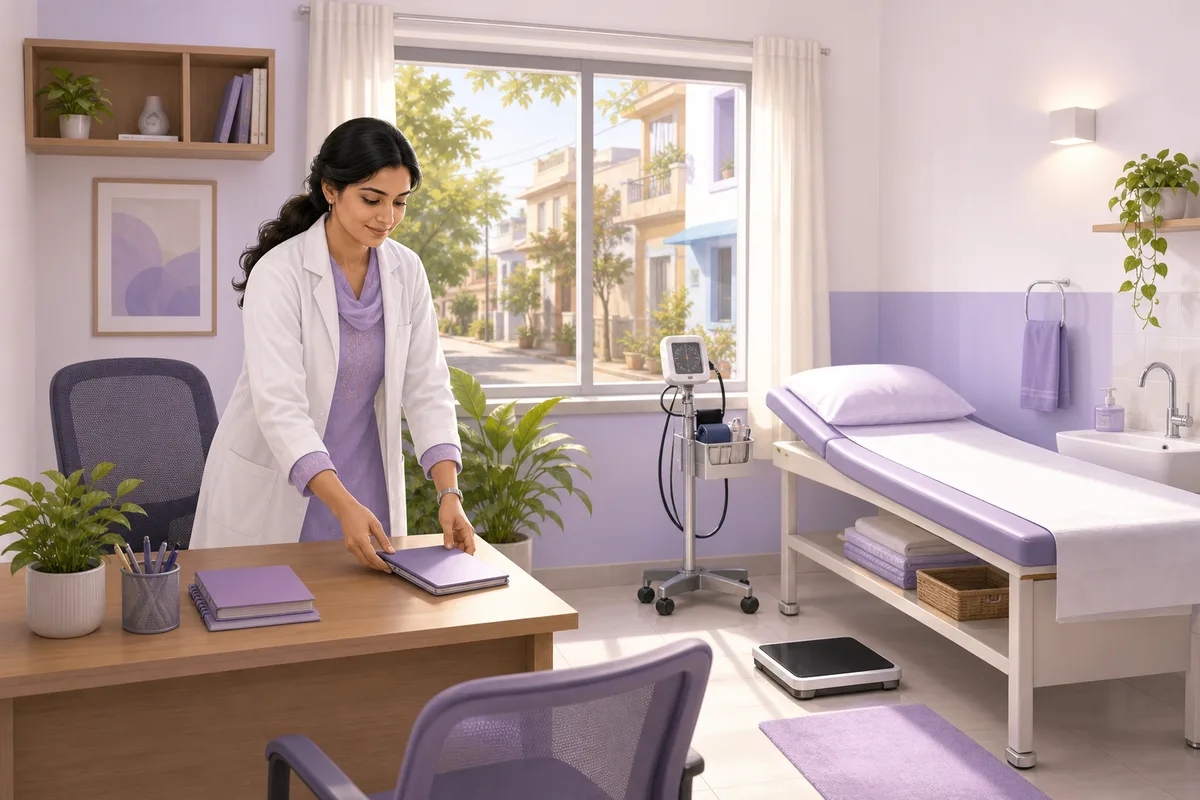
A GP clinic doesn't need much, but what it has should work every time. Prices below are rough ranges that vary a lot by city and brand.
| Item | Must-have / Nice-to-have | Rough cost band |
|---|---|---|
| Doctor's desk, chair and two patient chairs | Must-have | ₹15,000–50,000 |
| Examination couch with step and a privacy screen | Must-have | ₹8,000–25,000 |
| Stethoscope, BP apparatus (and a validated automatic one for the front desk) | Must-have | ₹5,000–20,000 |
| Thermometer, pulse oximeter, glucometer | Must-have | ₹3,000–10,000 |
| Weighing scale, height measure, paediatric scale if you see infants | Must-have | ₹3,000–15,000 |
| Torch, tongue depressors, otoscope and ophthalmoscope | Must-have | ₹5,000–25,000 |
| Nebuliser | Must-have for most GPs | ₹2,000–6,000 |
| Emergency tray (oxygen, Ambu bag, airway, emergency drugs as your training and council guidance suggest) | Must-have | ₹15,000–40,000 |
| Dressing and minor procedure set, sharps containers, colour-coded BMW bins | Must-have | ₹5,000–20,000 |
| Refrigerator for vaccines, with a thermometer log | Nice-to-have, essential if you vaccinate | ₹15,000–40,000 |
| ECG machine | Nice-to-have | ₹30,000–1.5 lakh |
| Printer for prescriptions | Must-have | ₹8,000–20,000 |
| Waiting room seating, reception desk, signboard | Must-have | ₹30,000–1.5 lakh |
| Inverter or UPS | Must-have | ₹10,000–40,000 |
Comfort is equipment too. Good light over the couch, a hook for bags, a chair for the attendant. They cost little and patients remember them.
Nimo tip: Run a full mock day before you open — a staff member walks in as a "patient" with a fever, gets registered, sees you, gets a prescription printed and pays. Every gap you find on that day is a gap a real patient won't hit.
Lab tie-ups and pharmacy
For a GP, these two relationships quietly decide how organised your clinic feels to patients.
Lab tie-ups. Most small clinics don't run their own lab at first. Instead:
- Partner with a nearby accredited lab that offers sample collection at your clinic or at the patient's home. Ask about collection timings, turnaround for routine tests (CBC, blood sugar, lipid profile, thyroid, renal and liver function, urine routine), and how reports reach you.
- Agree how reports come back. A report sitting in the patient's email that they forget to show you helps no one. Ask the lab to share reports with you as well, and decide where you'll file them.
- Be transparent about pricing. Patients should know the lab's rates. Your council's ethics code has views on referral payments and commissions; read it, and keep your arrangements clean.
Pharmacy. You have three broad options:
- Prescribe only, and let patients use any pharmacy. Simplest paperwork, no stock to manage. Introduce yourself to the two or three nearest pharmacists and ask what they usually stock, so your prescriptions don't send patients searching.
- Keep a small dispensing stock for your own patients. Some doctors do this for common medicines. Find out what your state permits and what records you need to keep, and stay strictly within it.
- Run a pharmacy counter open to the public. That's a retail pharmacy business with its own drug licence and staffing requirements. Treat it as a separate project — ask your state drug control department before committing.
Write clearly whichever you choose. Generic name, strength, frequency, duration, and instructions in a language the patient reads. Legible, printed prescriptions are kinder to patients and to pharmacists.
Referral network. Keep a short list of trusted specialists and the nearest hospital with emergency services, with timings and numbers. When you refer, send a short note; when they send a patient back, read theirs.
How a consult flows
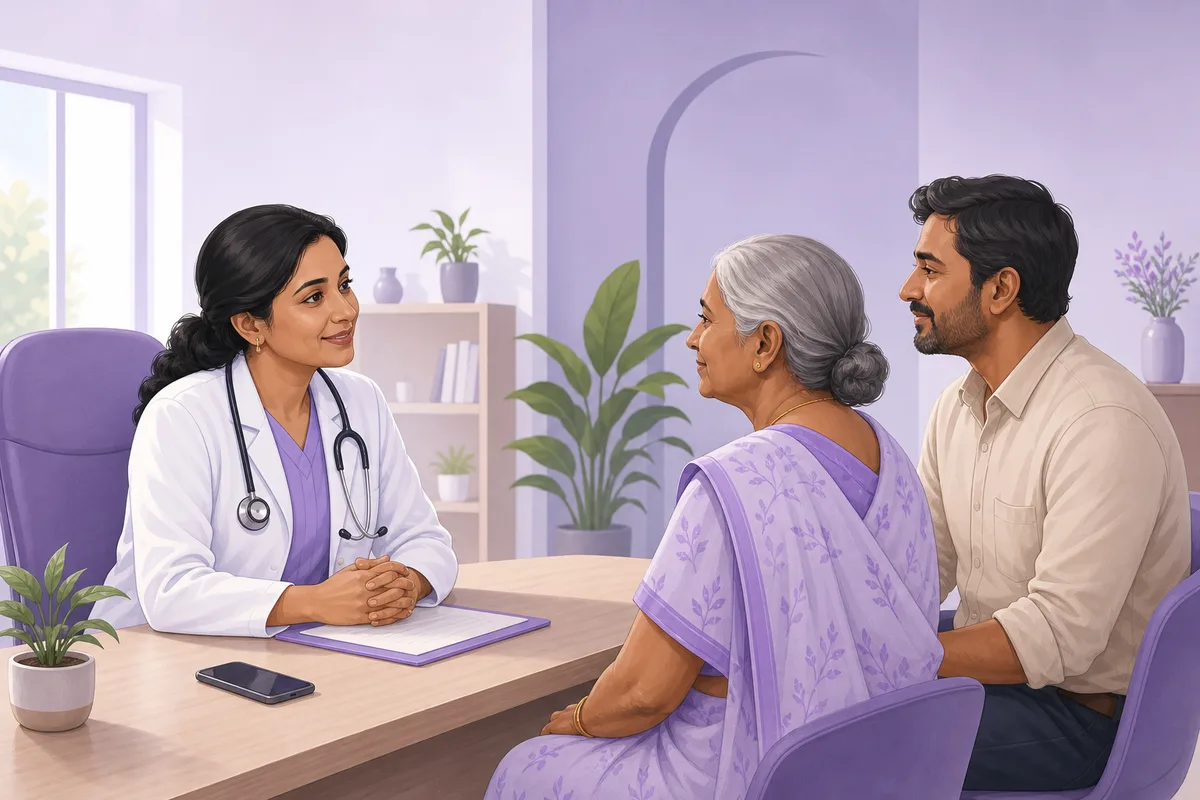
First visit (10–20 minutes):
- Front desk (2–4 min) — registration (name, mobile, age, sex), and vitals: BP, weight, temperature, SpO₂, sugar if relevant. A trained receptionist or assistant can take most vitals.
- History (4–8 min) — presenting complaint in the patient's words, then past history, medications, allergies, family and social history. For a new patient, this is your one chance to build the baseline.
- Examination (3–5 min) — focused on the complaint, plus whatever the baseline needs.
- Plan and prescription (3–5 min) — explain what you think is going on, what you're prescribing, what to watch for, and when to come back. Tests ordered with a clear reason.
- Front desk handoff (1–2 min) — payment, follow-up booked or noted, lab collection arranged.
Follow-up visits (5–10 minutes) — vitals, a quick review of the last note, what's changed, adjust the plan. For chronic conditions (diabetes, hypertension, thyroid, asthma), it helps to see the trend over visits rather than a single reading.
Peak hours. Mornings and evenings fill first. Mix booked slots with walk-in time, and leave slack — the patient with chest pain doesn't book.
Pricing your consult
There's no right number, only a number that fits your neighbourhood, your training and how you want to practise. These are rough ranges that vary a lot by city and area — do your own local survey.
- Consultation fee. GP consultations in many smaller towns sit in the ₹200–₹400 band; in metros, ₹400–₹800 or more is common. Visit or call three or four nearby clinics to find the local band.
- Follow-up policy. Many GPs offer a free or reduced follow-up within a set number of days for the same complaint. Decide your window and put it on the board so the front desk doesn't have to negotiate.
- Procedures and services. Price dressings, injections, nebulisation, ECG and certificates separately and clearly.
- Chronic-care packages. For patients you'll see monthly — diabetes, hypertension — some GPs offer a quarterly review package that includes visits and a set of routine tests through the partner lab. Keep it simple and written.
Don't underprice to compete. A GP who charges a fair fee and spends ten real minutes with each patient usually builds a more loyal practice than one who's cheapest and rushed.
Your first 50 patients
Your council's ethics code governs how doctors can present themselves — boards, listings and social media. Keep it factual: name, qualifications, registration number, services, hours, contact. No superlatives, no discount offers, no testimonials presented as advertisements. Within that:
- A complete Google Business Profile. Real photos, accurate hours (update them on holidays), services listed, a phone number someone answers, and a booking link. Ask satisfied patients for honest reviews.
- A booking link and a simple clinic page, so office-goers can book an evening slot from their desk.
- Introduce yourself in person — to pharmacists, labs, nearby specialists, school nurses, and the residents' associations within 1–2 km. A visiting card and a five-minute conversation go a long way.
- Health talks and camps where they're welcomed — a BP and sugar screening at a residents' association, a talk on monsoon fevers at a school. Give people a written note of their readings and encourage them to see their own doctor, whoever that is.
- Treat the first patient's family well. In general practice, one family member who trusts you brings the parents, the children and the in-laws.
Records, notes and software
Paper, honestly. Many GPs run excellent practices on a register and a prescription pad. The pad goes with the patient; the register holds a line or two. It's cheap and fast — until a patient returns after a year and neither of you remembers which BP medicine they were on, or which antibiotic gave them a rash. If you stay on paper, give every patient a file number and keep a one-page summary of allergies, chronic conditions and long-term medicines at the front of each file. A case sheet or a SOAP note format can help structure it.
Digital, honestly. Software is only worth it if it's quicker than the pad in a 7-minute consult. Before choosing, try writing three real-style prescriptions on it while someone times you.
Where Nimo fits. Nimo is a calm assistant built for small clinics, and for a GP it handles the daily work around the consult:
- Patient records with history, allergies and vitals over time, so a BP or sugar trend is a glance, not a hunt.
- Prescriptions with Indian frequency conventions (OD, BD, TID, HS, SOS), templates for the combinations you write every day, and a clean printed Rx.
- Appointments, a booking link and a walk-in QR poster, with Google Calendar sync — booked and walk-in patients in one queue.
- A receptionist role that can book, check in and record vitals, without seeing clinical notes.
- Your own free clinic page at gonimo.in/your-clinic-name — see free clinic website and clinic booking link.
The Free plan is ₹0 — one doctor, up to 100 visits a month, the booking link, walk-in QR, manual notes and prescriptions, and Google Calendar sync. When the OPD gets busy, Pro (₹999/month or ₹9,999/year) adds up to five doctors, unlimited visits and auto visit notes: Nimo listens to the consultation, transcribes it and drafts a structured note for you to review and finalise. You can start free for your clinic or try it first.
Nimo tip: Whatever system you use, write the allergy in the same place every time. The one record that must never be missed should never have to be searched for.
Opening-day checklist
- State medical council registration valid for this state; certificate displayed
- Clinical establishment registration (or provisional) in hand, where your state requires it
- Bio-medical waste authorisation and CBWTF agreement signed; first pickup scheduled
- Sharps containers and colour-coded bins in the consult and procedure areas
- Trade licence / Shops & Establishment registration done
- Drug licence question settled — either not needed for how you'll work, or applied for
- Emergency tray checked; oxygen cylinder full; staff know where everything is
- BP apparatus, glucometer and thermometer tested and calibrated
- Vaccine fridge running with a temperature log, if you vaccinate
- Lab tie-up confirmed — collection timings, rates, how reports reach you
- Nearby pharmacists introduced to; you know what they stock
- Referral list of specialists and the nearest emergency hospital on the wall
- Fee schedule and follow-up policy agreed and displayed
- Payment options ready — cash and a UPI QR at minimum
- Google Business Profile live with photos, hours and booking link
- Walk-in QR poster on the reception wall
- A full mock patient day run with your staff
Things nobody tells you
- You'll be judged on the waiting, not the consultation. Patients rarely know whether your diagnosis was textbook. They know whether they waited 15 minutes or 90. Protect your start time like a surgeon protects theirs.
- The first three months are quiet. That's normal. Use the quiet hours to write your templates, call the specialists on your referral list, and make the clinic run smoothly before it's busy.
- Your receptionist is your reputation. The person who answers the phone decides whether a new patient comes in. Hire for warmth and patience; teach the rest.
- Say no to things you can't sustain. Late-night home visits, your personal mobile on every prescription, free consults for everyone in the building — each feels kind in month one and becomes resentment in month twelve. Set boundaries early and kindly.
- Chronic patients are the heart of a general practice. The diabetic who sees you every month for five years matters more to the clinic than the fifty one-time fevers. Track their trends, remember their families, and book their next visit before they leave.
- Refer early, refer warmly. Patients don't think less of a GP who says "I'd like a specialist to see this". They think less of one who held on too long.
- Take a real lunch break. A solo GP who works through lunch every day makes worse decisions at 7 pm. The clinic needs you for decades, not just this month.
Where to go next
- Nimo for general practice and modern medicine — prescriptions, records and booking for a GP clinic.
- How to start a clinic in India — the wider, specialty-neutral guide.
- Clinic setup cost in India — a closer look at budgets.
- Your first 90 days in a new clinic — what to focus on after opening day.
- Free SOAP note format — a structure for quick, complete visit notes.
- All clinic resources — playbooks for every specialty, tools and checklists.
10 more chapters are waiting
Paperwork, the room, pricing, your first 50 patients, an opening-day checklist and the things nobody tells you. Tell us a little about you and Nimo opens them all.
General guidance, not legal or medical advice — rules differ by state, so confirm with your council and local body. More for new clinics in Resources.