

How to start a dental clinic in India: the Nimo playbook
One chair, one autoclave, and a lot of good decisions.
- Typical space
- 250–400 sq ft for one chair
- Time to open
- 8–14 weeks
- Registers with
- State dental council
12 chapters · about 15 min read · updated
The 60-second version
- Start with one chair, done properly. A well-run single-chair operatory with a separate sterilisation corner beats two half-equipped chairs. You can add a second chair once the first is booked out.
- Location is about visibility, water and power, not just rent — plus somewhere patients can park a scooter.
- The paperwork is longer than for a general OPD — dental council, clinical establishment registration where required, bio-medical waste, trade licence, and AERB registration through eLORA before any X-ray unit is used.
- Sterilisation is your reputation. Patients cannot judge your endodontics, but they can see whether you open a sealed pouch in front of them.
- Price procedures in bands, and write the treatment plan down. Most disputes in dental practice are about money that was never clearly explained before the work started.
- Your first 50 patients come from within 2–3 km — a good Google Business Profile, a booking link, camps where permitted, and referrals from nearby doctors.
- Chart every tooth, every time. The tooth chart and a phased plan are what make a recall visit, an insurance letter or a second opinion painless.
Before you sign a lease
Footfall versus findability. Dental care is more planned than walk-in medicine — people search before they book. A first-floor clinic on a busy road with a clear board can beat a pricier ground-floor shop on a quiet lane. But if your area skews older, or you want families with small children, stairs are a real barrier.
Utilities matter more than for most specialties. Before you commit, check:
- Water — steady supply and pressure for the chair, or room for a self-contained bottle system.
- Drainage — the spittoon and suction need a drain point. Ask the landlord where you can run a line.
- Power — compressor, autoclave and suction together draw real load. Check the sanctioned load, and budget for an inverter or UPS so a power cut never leaves a patient mid-procedure.
- Noise — compressors are loud. Plan a spot outside the operatory, or buy an oil-free silent model.
Room count. A practical single-chair layout has four zones, even if two of them share a wall:
- Reception and waiting (6–8 seats is plenty).
- The operatory — roughly 9–10 ft by 10–12 ft to work comfortably with an assistant.
- A sterilisation corner, away from the waiting area.
- A consult or X-ray corner. If you'll add an intraoral X-ray, ask your supplier about AERB layout and shielding requirements before you finalise walls.
Home clinic or commercial space? A home clinic can work in smaller towns, but check your housing society's rules and local zoning before you invest in plumbing — and know that it makes adding an associate harder later.
Neighbourhood fit. Young families mean preventive and paediatric work; offices mean evening slots and cosmetic enquiries; older areas mean dentures, extractions and implant conversations. Match your equipment and hours to who lives within 2 km.
Nimo tip: Before signing, visit the location at 7 pm on a weekday and 11 am on a Sunday. Those are the hours most working patients will want, and you'll learn more about parking, lighting and street noise than from any broker.
Paperwork and registrations
Dental clinics carry a few registrations that a general OPD does not. Rules differ by state — confirm each item with your state dental council and local body before you open. Treat the table below as a list of what to ask about, not legal advice.
| What | Who issues it | When |
|---|---|---|
| Registration as a dentist (BDS/MDS) | Your State Dental Council, under the Dental Council of India framework | Before you practise — you likely have this already; check it's current for the state you're opening in |
| Clinical establishment registration | State or district registering authority, where your state has adopted the Clinical Establishments (Registration and Regulation) Act 2010 or has its own law | Before opening; many states allow provisional registration first |
| Bio-medical waste authorisation and CBWTF tie-up | State Pollution Control Board (authorisation) and a Common Bio-medical Waste Treatment Facility (collection agreement) | Before your first patient — you'll generate sharps and contaminated waste on day one |
| AERB registration for dental X-ray (IOPA / OPG) | Atomic Energy Regulatory Board, applied for online through eLORA | Before the X-ray unit is used on patients; buy only models your supplier confirms are type-approved |
| Shops & Establishment registration / trade licence | Municipal corporation, panchayat or state labour department | Before opening |
| Fire NOC | Local fire department | Depends on building height, area and occupancy — thresholds vary, so ask |
| GST registration | GST department | Healthcare services by clinical establishments are generally exempt; cosmetic procedures and product sales may be treated differently — confirm with your CA |
| Signboard and listing content | Governed by your council's code of ethics | Before you put up a board or a website |
A few practical notes:
- AERB is the one people forget. Dentists mount an intraoral X-ray unit and only then hear about registration. Ask your supplier for the model's type approval details and help with eLORA, and keep the paperwork in a file you can show an inspector.
- Dental bio-medical waste includes sharps, burs and files, extracted teeth, contaminated cotton, and amalgam waste if you use it. Your CBWTF will tell you which colour-coded bins they expect.
Setting up the room
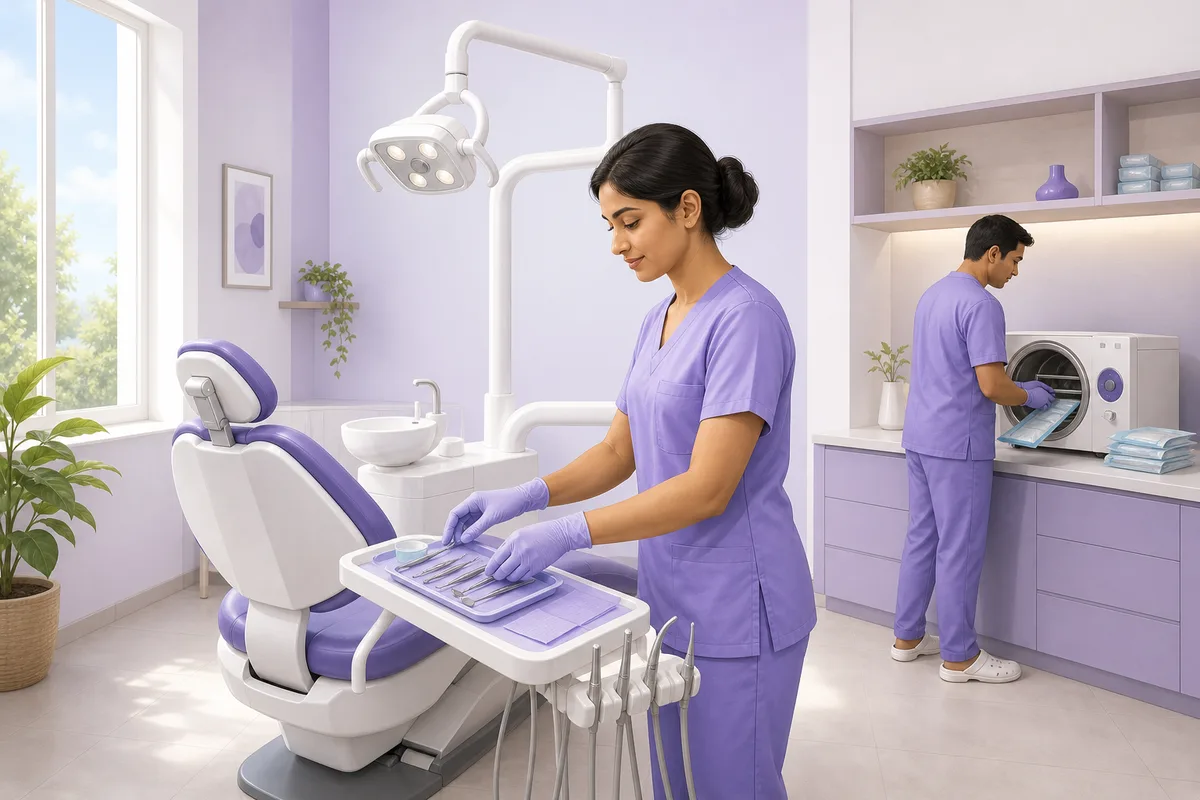
The chair is the biggest decision and the most tempting place to overspend. Buy for reliability and service availability in your city, not for the brochure. All prices below are rough ranges, and they vary a lot by city, brand and whether you buy new or refurbished.
| Item | Must-have / Nice-to-have | Rough cost band |
|---|---|---|
| Dental chair with light, spittoon, suction and delivery unit | Must-have | ₹1.5–6 lakh |
| Air compressor (oil-free preferred) | Must-have | ₹30,000–1 lakh |
| Autoclave (Class B if you can stretch) | Must-have | ₹40,000–2 lakh |
| Handpieces — airotor and micromotor, with spares | Must-have | ₹30,000–1.5 lakh |
| Ultrasonic scaler | Must-have | ₹10,000–50,000 |
| LED curing light | Must-have | ₹5,000–30,000 |
| Instruments (diagnostic, restorative, extraction, endo hand files) | Must-have | ₹50,000–1.5 lakh |
| Ultrasonic cleaner and pouch sealer | Must-have | ₹10,000–40,000 |
| Colour-coded BMW bins and sharps containers | Must-have | A few thousand |
| Emergency kit (oxygen, basic airway, emergency drugs as your council guidance suggests) | Must-have | ₹10,000–30,000 |
| Intraoral X-ray unit and RVG sensor | Nice-to-have at launch, near-essential by month three | ₹1.5–4 lakh |
| Endomotor and apex locator | Nice-to-have | ₹20,000–1 lakh |
| Intraoral camera | Nice-to-have | ₹10,000–50,000 |
| Operator stool, assistant stool, instrument trolley | Must-have | ₹15,000–50,000 |
| Waiting room seating, reception desk, signage | Must-have | ₹50,000–2 lakh |
| OPG or CBCT | Not at launch — refer out | Large |
What you can refer out at first: OPGs and CBCTs (most cities have a dental imaging centre), complex prosthetic lab work (tie up with a reliable dental lab — ask colleagues who they trust), and specialist work you don't do yourself.
Nimo tip: Ask every equipment dealer the same question: "If the chair breaks on a Saturday, who comes, and how fast?" The cheapest chair with a technician two hours away is the most expensive chair you'll own.
Sterilisation and X-ray
These two are where a dental clinic most visibly earns — or loses — trust.
Set up a one-way flow. Dirty instruments go from the operatory to a receiving area, then cleaning (ultrasonic, then rinse and dry), then inspection and pouching, then the autoclave, then clean storage. Clean and dirty should never cross on the same counter. Even in a 4 ft corner, mark it with tape if you have to: left side dirty, right side clean.
Make it visible. Open sealed pouches in front of the patient and change chair barriers between every patient. Patients notice, and tell their friends.
Write it down. Keep an autoclave log — date, cycle, indicator result, initials — and run the indicator tests your manufacturer recommends. When an assistant leaves, the log is how the next one learns the routine.
Handpieces are the weak spot. Buy enough that you're never tempted to skip a cycle because the next patient is waiting — three of each is a reasonable start.
X-ray, once you have it:
- Have the AERB registration in place before first use, and follow its guidance on protection for patients and staff.
- With an RVG sensor, file images against the patient's record the same day. A loose folder of JPEGs on a desktop is how images go missing.
How a consult flows
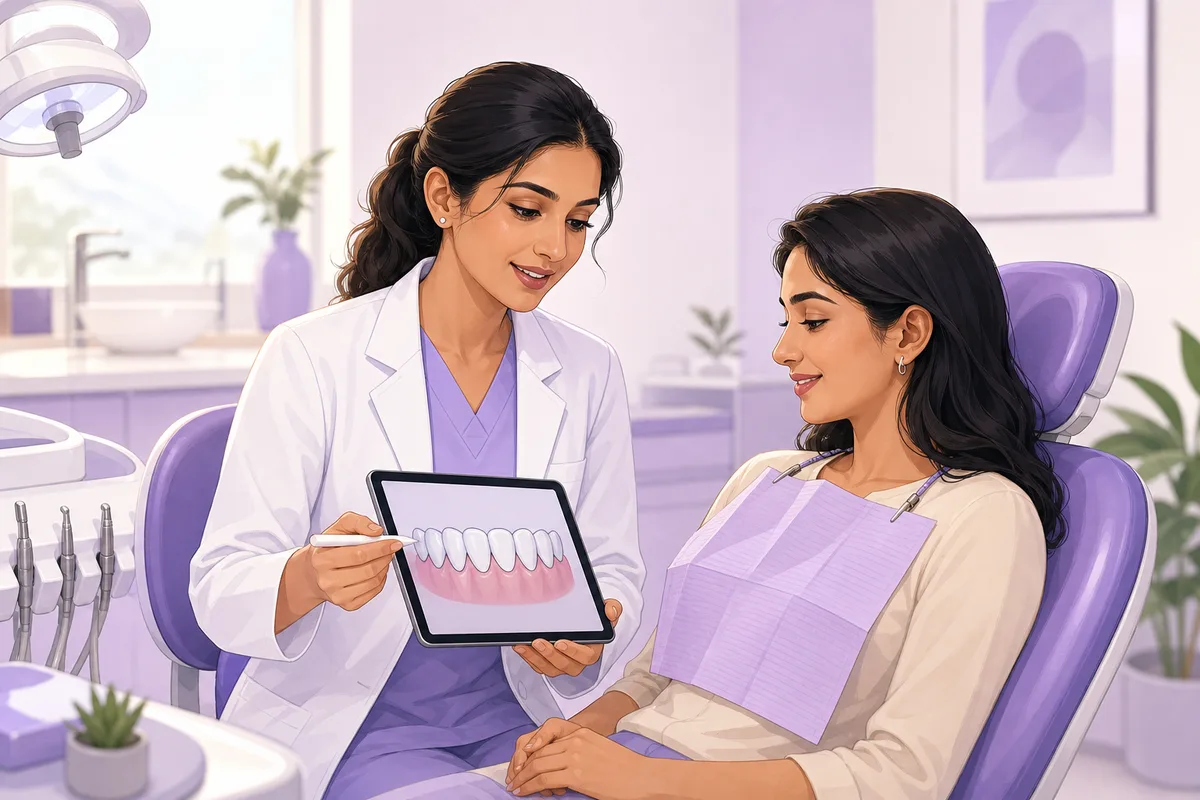
First visit (30–45 minutes):
- Front desk (5 min) — registration, contact, medical history form (diabetes, BP, blood thinners, allergies, pregnancy). This is where a receptionist earns their salary.
- Chief complaint and history (5–10 min) — the patient's words first. Then dental history and the medical history from the form, asked again in your words.
- Examination and charting (10–15 min) — extraoral and intraoral exam, a full tooth chart (caries, existing restorations, missing teeth, mobility, periodontal notes), and radiographs if needed.
- Explaining the plan (5–10 min) — show the patient what you found, ideally on an intraoral camera or the X-ray. Offer options, not just the most expensive one. Phase it: urgent first, then restorative, then elective.
- Front desk handoff (5 min) — estimate in writing, next appointment booked before they leave, payment for today.
Same-day treatment (scaling, a simple filling, an extraction) adds 20–40 minutes.
Treatment visits run 20–60 minutes. An RCT may span two or three visits; crown work waits on the lab. Give the front desk your procedure times so a molar RCT never lands in a 15-minute slot.
Recalls — six-monthly check-ups are the backbone of a sustainable practice. Book them before the patient leaves.
Pricing your consult
Dental pricing has two parts: the consultation, and the procedures. Here is how to think about both. Everything below is rough ranges that vary a lot by city, neighbourhood and your training — use them only as a starting point for your own local survey.
Consultation. Many clinics charge a modest consultation fee (often in the ₹200–₹500 band in smaller cities, more in metros) and waive or adjust it if the patient goes ahead with treatment that day. Decide your policy and write it on the wall so the front desk applies it consistently.
Procedures. Build a banded price list for your common work — scaling, composites, extractions, RCT by tooth, crowns by material, dentures — after checking what three or four nearby clinics charge. Far below the area makes patients wonder what you're skimping on.
Treatment plans as packages. For multi-visit work, give one written estimate with a range, the number of visits and what's included, and collect in stages tied to milestones.
Lab costs change your margins more than anything else — know your lab's rate for each crown type before you quote it. And whether whitening, veneers or aligners are treated differently for GST is a question for your CA.
Your first 50 patients
You cannot advertise the way a restaurant does — your council's ethics code governs what you can say on boards, listings and social media. Stay factual: name, qualification, registration number, services, hours, contact. No "best dentist", no discount banners, no before-and-after images unless your council's guidance is comfortable with them. Within that, there is a lot you can do.
- Google Business Profile, completed properly. Real photos of the clinic and the sterilisation area, accurate hours, your services listed, and a booking link. Ask happy patients for a review — honestly, without incentives.
- A booking link and a simple clinic page. Most new patients will look you up before calling. Make it easy for them to pick a time at 11 pm when the toothache starts.
- Referral doctors nearby. Visit the GPs, paediatricians and gynaecologists within 2 km and offer to see their urgent dental referrals the same day. A short note back after each one keeps referrals coming.
- School and workplace screening camps, where your council allows them. Screen, educate, give a written note — and don't use the camp to sell.
- Talks at a residents' association or parents' meeting about children's teeth or gum health do more than a banner.
- Be the clinic that sees emergencies. Keep one or two slots a day open for pain. A patient you relieve on a Sunday morning becomes a patient for life, and brings their family.
Records, notes and software
Paper, honestly. A paper case sheet with a printed tooth chart works, and it's cheap. Many excellent dentists still use it. The problems show up later: a patient returns after 14 months and you can't find the radiograph; an RCT spans three visits and the working lengths are on a scrap of paper; a patient asks for their treatment summary for an insurer and you spend 20 minutes reconstructing it. If you stay on paper, use a numbered, pre-printed case sheet, and file it the same day. Our free dental case sheet and the guide to writing a dental case history can help.
Digital, honestly. Software only helps if it's faster than paper with gloves coming on and off. Try charting one full mouth on it in under three minutes before you choose.
Where Nimo fits. Nimo is a calm assistant for small clinics, and for a dental practice it keeps the parts that usually get lost in one place:
- A tooth chart you tap — mark caries, fillings, RCTs, crowns and missing teeth in FDI, Universal or Palmer numbering (if you're switching between systems, the tooth numbering guide has a conversion table).
- A phased treatment plan and a printable case sheet, so the estimate you discussed is the estimate on paper.
- Prescriptions with proper strengths, saved as templates for the antibiotics and analgesics you write every day.
- Appointments, a booking link and a walk-in QR, with Google Calendar sync, so walk-ins and online bookings share one chair schedule.
- Your own free clinic page at gonimo.in/your-clinic-name — see free clinic website.
The Free plan is ₹0 — one dentist, up to 100 visits a month, the booking link, walk-in QR, manual notes and prescriptions, and Google Calendar sync. When the chair is busy, Pro (₹999/month or ₹9,999/year) adds up to five dentists, unlimited visits, and auto visit notes: Nimo listens to the consultation, transcribes it and drafts the note for you to review. You can start free for your dental clinic or try it first.
Nimo tip: Whatever you use, chart the full mouth at the first visit — even teeth you're not treating. It takes three extra minutes and saves you every time a patient says "that filling was already there".
Opening-day checklist
- State dental council registration current, and certificate framed
- Clinical establishment registration (or provisional) in hand, where your state requires it
- Bio-medical waste authorisation and CBWTF agreement signed; first pickup scheduled
- AERB registration complete before the X-ray unit is switched on for patients
- Trade licence / Shops & Establishment registration done
- Chair, compressor, suction and autoclave tested with a full dry run
- Autoclave log book started, and the first indicator test recorded
- At least two sets of handpieces sterilised and pouched
- Emergency kit checked, and staff know where it is
- Price list for common procedures agreed and shared with the front desk
- Cash and UPI QR ready at the desk
- Dental lab and imaging centre tie-ups confirmed, with turnaround times
- Google Business Profile live with photos, hours and booking link
- Walk-in QR poster printed and on the reception wall
- Referral cards delivered to nearby GPs and paediatricians
- An emergency slot kept free every day for the first month
Things nobody tells you
- Your assistant matters as much as your chair. A trained chairside assistant doubles your speed and halves your stress. Hire for calm and reliability; you can teach four-handed dentistry.
- The compressor will fail at the worst moment. Keep the technician's number on the wall and one morning a month free of procedures so maintenance never has to wait.
- Estimates protect friendships. The patients most likely to dispute a bill are the ones you know personally, because you were vague with them. Write the estimate down for everyone, especially family friends.
- Your first six months will feel empty, then suddenly full. Recall patients are slow to build and then compound. Book every six-monthly recall before the patient leaves the chair — the clinic you have in year two is built in month one.
- Children are a referral engine. A parent whose child had a gentle first visit will bring the whole family. Keep a box of stickers and allow ten extra minutes for every child under eight.
- Your back is a business asset. Set the chair height, your stool and the patient's position correctly from the first day. Dentists who ignore ergonomics in their thirties pay for it in their forties.
- Not every case is your case. Referring a difficult third molar or a complex endo re-treatment to a colleague isn't lost revenue; it's a patient who trusts you more. They come back for everything else.
Where to go next
- Nimo for dental clinics — what the tooth chart, case sheet and booking link look like in practice.
- How to start a clinic in India — the broader, specialty-neutral guide.
- Clinic registrations and licences in India — a longer look at the paperwork, and what to ask your state.
- Paper vs digital dental case records — an honest comparison.
- Free dental case history guide — the standard format, with a worked example.
- All clinic resources — playbooks for every specialty, tools and checklists.
10 more chapters are waiting
Paperwork, the room, pricing, your first 50 patients, an opening-day checklist and the things nobody tells you. Tell us a little about you and Nimo opens them all.
General guidance, not legal or medical advice — rules differ by state, so confirm with your council and local body. More for new clinics in Resources.